

Wright's 1932 Sketch Became the Field's Permanent Frame
In 1932, Sewall Wright stood before the Sixth International Congress of Genetics and introduced a picture that would outlast nearly every other idea in the room. He drew a two-dimensional surface with peaks and valleys, each point representing a combination of gene frequencies in a population, and asked the audience to imagine evolution as movement across this surface toward higher fitness. Wright called this picture an adaptive landscape; the term fitness landscape emerged later as the broader mathematical generalization. The metaphor was powerful enough to become permanent. Nine decades later, many fields that study search, adaptation, optimization, or design invoke "landscapes" in some form. [2]Citation 2
Wright was born in Melrose, Massachusetts, and grew up in Galesburg, Illinois, where his father taught at Lombard College. He earned his doctorate at Harvard under William Castle and spent most of his career at the University of Chicago. His 1932 address introduced the adaptive landscape as a way to think about how populations of organisms navigate the space of possible gene combinations. The metaphor was so vivid that it took decades for the field to realize how much it could mislead: the two-dimensional picture Wright drew behaves nothing like the high-dimensional spaces that real evolution inhabits. His shifting balance theory, which proposed that small populations could drift across valleys to reach higher peaks, remained controversial for the rest of his life. [2, 3]Citation 2, 3
A Landscape Has Three Components; Search Adds a Fourth
Reidys and Stadler formalized the static structure of a combinatorial landscape as a configuration space equipped with a notion of adjacency and mapped into real-valued scores. In their decomposition, a landscape is a triple:
A landscape consists of three components:
- Configuration space (X): all the possible options. Every combination of choices, settings, or sequences the system could take.
- Neighborhood structure (N): which options are one step apart. The rule that defines what counts as a reachable move from wherever you currently stand.
- Value function (f): how good each option is. The score assigned to every configuration.
These three pieces define the terrain: what you could try, which options connect to which, and how each one scores.
To explain how a system actually moves through the terrain, we need one more piece:
A search system extends the landscape with a fourth component:
- Dynamics (D): how you actually search. The rule or process that decides which configuration to move to next.
Throughout this course, "the landscape" refers to the static terrain (X, N, f), and "the dynamics" refers to whatever process explores it. Two different search processes on the same landscape can reach very different outcomes. [1]Citation 1
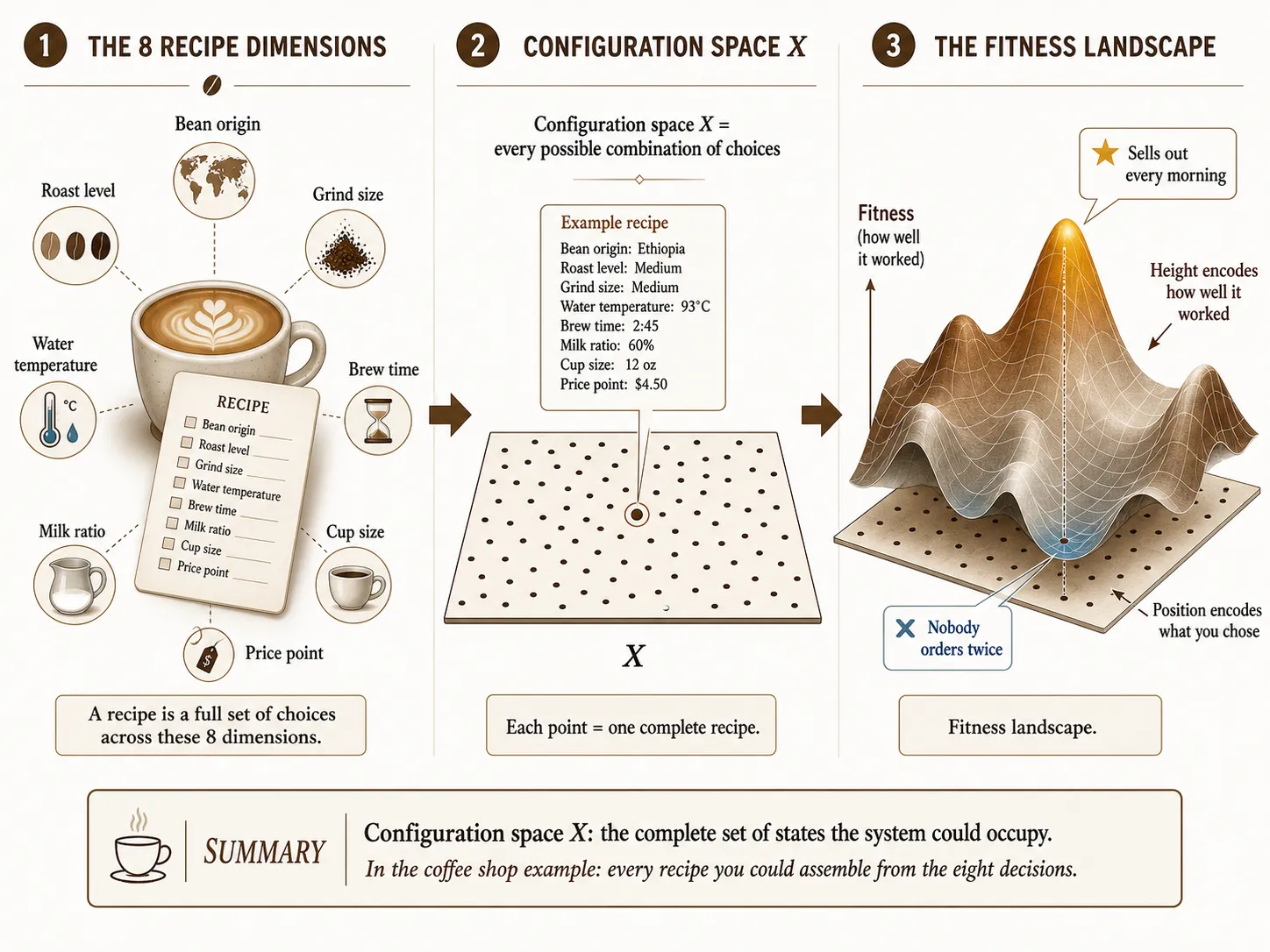
Suppose you run a coffee shop and you are searching for the best recipe: bean origin, roast level, grind size, water temperature, brew time, milk ratio, cup size, price point. Every possible combination of those eight choices is one configuration. Some configurations produce a drink that sells out every morning; others produce something nobody orders twice. If you could lay all possible recipes on a vast plain, then raise or lower the ground at each point based on how well that combination sells, you would have a fitness landscape: position encodes what you chose, height encodes how well it worked. The four components defined above map directly onto this picture: all possible recipes (X), which recipes are one ingredient apart (N), how well each recipe sells (f), and how you decide what to try next (D). The sections below expand each component in detail.
The configuration space X is every possible combination of choices the system could make. In the coffee shop, it is every recipe you could assemble from those eight decisions. More compactly: the complete set of states the system could occupy. The space is almost always too vast to check exhaustively, because each independent choice multiplies the total. Eight decisions with ten options each already yield 10^8 combinations. A protein of 100 amino acids, each drawn from 20 possibilities, produces 20^{100} \approx 10^{130} possible sequences. A neural network with a million continuous parameters inhabits a region of \mathbb{R}^{10^6}. The size of the space is the first thing that makes search hard.
A protein has 100 amino acid positions, each with 20 possible amino acids. Adding one more position to the sequence changes the configuration space how?
Each position multiplies the number of possible sequences by 20. A 100-position protein has 20^{100} sequences; a 101-position protein has 20^{101}, which is 20 times larger. This multiplicative compounding is why configuration spaces explode beyond any possibility of exhaustive search: the space does not grow with its parts, it grows as a power of its parts.
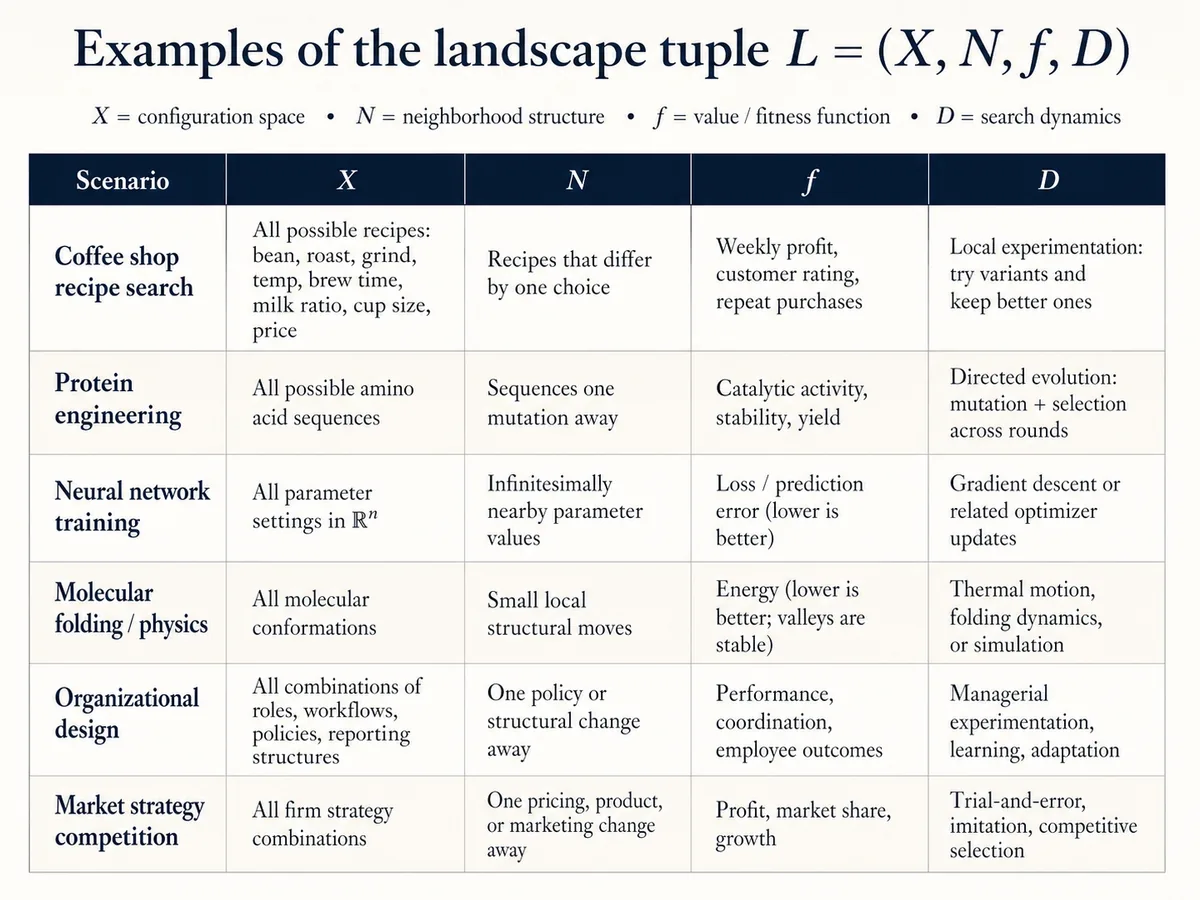
The neighborhood structure N defines which configurations you can reach in a single step from wherever you currently stand. In the coffee shop: if you can only change one decision at a time (switch from medium roast to dark roast, or raise the price by a dollar), then your neighbors are all recipes that differ from your current one by exactly one choice. The move rule defines what "nearby" means, and that definition controls where search can go next. The same set of configurations under a different neighborhood produces a completely different landscape: what looks like an inescapable local peak under single-variable changes might be easily escaped if you can change three variables simultaneously. If the configuration space is DNA sequence, neighbors under point mutation differ at one nucleotide position. If the space is protein sequence, single-substitution neighbors differ at one amino acid residue. In a neural network trained by gradient descent, neighbors are infinitesimally close in parameter space. In an organization, a neighbor might differ by one policy change or one departmental reorganization.
Assume two labs use the same protein sequence space X and the same assay-defined fitness function f. In this lesson, the neighborhood N is defined by what the experiment can generate in one move. Lab A's one move is a single amino acid substitution. Lab B's one move is DNA shuffling, which can recombine whole segments. Under this definition, are they searching the same landscape?
Same protein and same assay establish only two of the three landscape components: the configuration space (X), the sequence space under consideration, and the value function (f), the score assigned by the assay. They do not establish the neighborhood (N), the one-step move rule. Under point mutation, a sequence's neighbors are variants one residue away. Under DNA shuffling, its neighbors can be recombined variants that differ across whole segments. Because a local peak means "fitter than every allowed one-step neighbor," changing the neighborhood (N) can change whether the same sequence counts as a peak. If every one-residue mutant of sequence S scores lower but one shuffled recombinant scores higher, S is a peak for Lab A and not for Lab B. The labs share the heights, but not the roads between them.
The value function f assigns a score to every configuration: how good is this particular combination? In the coffee shop, it might be weekly profit, customer satisfaction rating, or repeat-purchase rate. The score is whatever you are trying to maximize (or minimize), and it determines which points on your landscape sit high and which sit low. Different scoring criteria produce different landscapes over the same configuration space, because the peaks move when you change what counts as "good." In evolutionary biology, the score is reproductive fitness. In protein engineering, catalytic activity or thermal stability. In physics, the score is energy, with the convention reversed: lower is more stable. In machine learning, prediction error, again with lower being better. Across disciplines, check the sign convention. A "peak" in one field's landscape is a "valley" in another's.
In a fitness landscape, a peak represents the best local outcome. In an energy landscape, a valley represents the most stable local state. Are these structurally different?
Mathematically, maximizing fitness and minimizing energy are equivalent after flipping the sign of the value function. A local fitness peak and a local energy valley share the same structure: a configuration that scores better than all its neighbors. The sign flip captures the optimization geometry, and that insight (option B) is valuable. Physical energy landscapes, however, carry additional structure: temperature-dependent transition probabilities, kinetic barriers, and thermodynamic constraints that shape how the landscape is explored. These constraints affect the dynamics (D) and therefore the outcomes of search. The sign flip captures the abstract optimization problem; the full physical picture is richer.
The dynamics D is your method of exploration: the process that actually moves you from one configuration to another. It determines which parts of the space you visit, how quickly, and in what order. In the coffee shop: do you tweak one ingredient at a time and keep any change that sells better? Do you throw darts at the board and try random combinations? Do you hire a consultant to model customer preferences and recommend a specific untested recipe? Each search method will find different solutions, get stuck in different places, and take different amounts of time, all on the same landscape. The landscape (X, N, f) is the terrain; the dynamics (D) is the walker. In biology, the dynamics is mutation plus natural selection operating across generations. In machine learning, gradient descent updating parameters toward lower loss. In markets, firms experimenting with strategies and imitating successful competitors. Dynamics is the component most often conflated with the landscape itself, and distinguishing the two is the central lesson of this unit.
Gradient descent and evolutionary search are applied to the same neural network loss landscape (same architecture, same training data, same loss function). Gradient descent converges to minimum A; evolutionary search converges to minimum B, which has lower loss. Why did the two algorithms find different minima on the same surface?
The landscape (X, N, f) is fixed by the network architecture and training data. Both algorithms traverse the same surface. What differs is the dynamics (D): gradient descent follows the local slope and gets trapped in whichever basin it enters first, while evolutionary search maintains a population of diverse solutions and can cross valleys that gradient descent cannot. The terrain stayed the same; the walker changed, and so did the destination.
Every Experiment Defines Its Own Landscape
A protein of 100 amino acids has 20^{100} possible sequences. Assigning a value to each one is impossible. A directed-evolution experiment resolves this by constructing a local, assay-defined version of the landscape and pairing it with a specific search dynamics, where every component of the search system corresponds to a concrete experimental choice. [55]Citation 55
The experimental configuration space is the set of variants the experiment allows itself to consider. It might comprise all single amino-acid substitutions in a short protein region, all combinations of mutations at five known resistance positions, all variants generated by error-prone PCR, or all 20^4 = 160{,}000 amino-acid combinations at four chosen sites. The space is almost always a deliberately bounded region of sequence space, shaped by structural knowledge, practical constraints, and the mutation technology available.
The experimental neighborhood is defined by what counts as a reachable move. Single-point mutagenesis produces neighbors differing by one residue. DNA shuffling recombines chunks from different parent sequences, generating neighbors many mutations apart. Site-saturation mutagenesis allows all substitutions at selected positions. Machine-learning-guided synthesis can propose variants far from the current sequence, expanding the effective neighborhood beyond anything a single mutation step could reach.
The experimental value function is the assay readout, and this is where the sharpest departure from the formal picture occurs. Every experiment measures a specific proxy: catalytic rate under stated conditions, fluorescence intensity in a cell sorter, survival at a given antibiotic concentration, thermal stability after heat treatment, or binding enrichment after selection. The hat in \hat{f}(x) marks measurement uncertainty and assay dependence: the score estimates performance under the assay's specific conditions, and it can change completely when the assay changes. A GFP variant scoring high for brightness may score poorly for folding speed. A beta-lactamase mutant conferring strong cefotaxime resistance may prove less effective against ampicillin. The assay defines the value function, so the landscape changes when the assay changes.
Two teams study the same enzyme. Team A measures catalytic activity and calls the result 'fitness.' Team B measures thermal stability and calls their result 'fitness.' Are they studying the same landscape?
The two teams share the same configuration space (X): all possible sequences of this enzyme. They potentially share the same neighborhood (N), if both use the same mutation process. They have different value functions (f). Since the landscape is the triple (X, N, f), changing the value function changes the landscape. Peaks under catalytic activity may be valleys under thermal stability. The correlation between the two measurements is an empirical question, and many directed-evolution studies find that activity and stability trade off against each other. The \hat{f} notation forces the reader to ask which assay produced the score.
The experimental dynamics is the laboratory cycle itself: diversify the gene, express the variants, apply the assay, select or screen the best performers, recover their DNA, and repeat. Changing the selection threshold, the mutation rate, the population bottleneck, or the recombination protocol changes the dynamics, which changes which regions of the space get explored and which optima become accessible.
Lab Choices Produce a Local Projection
What does the four-component search system look like in a single real experiment? Frances Arnold's early work on subtilisin E maps each component to a concrete laboratory choice. [64]Citation 64
Arnold wanted to evolve a protease that stayed active in 60% dimethylformamide (DMF), a harsh solvent that destroys most enzymes. The configuration space (X) was all protein sequences reachable from the wild-type enzyme through a small number of amino-acid substitutions. The neighborhood (N) was defined by error-prone PCR, which introduced a few random point mutations per gene each round. The value function (f) was an assay for casein hydrolysis: colonies secreted subtilisin variants onto agar plates containing casein and DMF, and active variants digested the casein to produce visible halos. Larger halos indicated higher activity under the solvent condition. The dynamics (D) was the laboratory cycle itself: mutagenize, plate, measure halos, pick the best colonies, extract their DNA, mutagenize again.
After several rounds, the evolved enzyme had 256-fold higher activity in DMF than the wild type. The experiment sampled a tiny fraction of the protein's vast sequence space and assigned scores only to the variants it actually produced. It found a local region of high performance by following a gradient defined by one particular assay, using one particular mutation method. The landscape this experiment traversed was real and informative, yet it remained a local projection: a small neighborhood of sequence space, scored by one proxy, explored by one search process.
Arnold trained in mechanical and aerospace engineering at Princeton, then shifted to chemical engineering at Berkeley. Her insight was that evolution could be applied deliberately in the lab: instead of designing a better enzyme from first principles, one could mutate, screen, and select, letting the process of variation and selection do the design work. The subtilisin experiments of the early 1990s demonstrated that this iterative cycle could produce enzymes with properties that rational design had failed to achieve. Arnold received the Nobel Prize in Chemistry in 2018 for her work on directed evolution of enzymes. [55, 64]Citation 55, 64
In Pooled Assays, Fitness Is Inferred from Relative Frequency Change
"Fitness" in landscape studies carries a narrower meaning than the everyday word suggests. It does not mean "good" or "well-adapted" in some absolute sense. It means: how well a variant performed relative to others under one specific imposed test. A variant is "fit" if it became more common after selection; "unfit" if it declined. Change the test, and the same variant's fitness can flip from positive to negative.
The subtilisin experiment above screened colonies one at a time. Modern high-throughput methods test thousands or millions of variants simultaneously. Deep mutational scanning works by pooling all variants in a single experiment, applying a selection pressure, then sequencing the pool before and after to see which variants became more or less common. Variants enriched by selection receive positive scores; variants depleted receive negative scores.
The simplest enrichment score takes this form:
Here p_{i,\,\text{before}} is the frequency of variant i in the library before selection, and p_{i,\,\text{after}} is its frequency afterward. A variant that increased from 0.01% to 0.1% of the pool grew tenfold; its log-enrichment is positive. One that fell from 0.1% to 0.01% shrank tenfold; its score is negative. Production analyses add pseudocounts, replicate modeling, sequencing-error correction, and normalization controls, because raw enrichment can be distorted by drift, sampling noise, or sequencing artifacts. The conceptual core remains: relative performance under the imposed selection, inferred from frequency change.
An enrichment score is meaningful only together with the assay that produced it. A mutation improving catalytic activity may reduce thermal stability. A mutation enhancing binding to one target may increase off-target binding. A mutation boosting fluorescence may slow folding or expression. Researchers sometimes collapse multiple objectives into a single assay, as when survival under antibiotic pressure implicitly combines expression, folding, activity, and cellular burden. Sometimes they impose sequential constraints: first select for activity, then heat-treat, then screen for remaining activity. And sometimes they keep the objectives separate and analyze a Pareto front of variants where improving one trait requires sacrificing another. (That distinction receives its own full treatment later in the course.)
Same Terrain, Different Walker, Different Peak
Consider the protein space for a 100-amino-acid enzyme. The configuration space X contains 10^{130} sequences. The value function f scores each sequence for catalytic activity. The neighborhood N says two sequences are neighbors if they differ at one amino acid position. The landscape (X, N, f) is fixed. What changes dramatically across the following scenarios is the dynamics:
A microbial population searches this landscape through mutation and natural selection over millions of generations, with population sizes large enough for selection to be effective and small enough for drift to matter. It explores a tiny, connected region of the space, following fitness gradients where they exist and drifting through neutral regions where they do not.
A directed-evolution laboratory imposes a different dynamics: create a library of variants through error-prone PCR or saturation mutagenesis, screen for activity, select the best, and repeat. The library samples a vastly smaller fraction of sequence space than natural evolution explores over long timescales, the selection is sharper and more targeted, and recombination can be applied deliberately rather than relying on its natural rate.
A Bayesian optimizer uses a Gaussian-process surrogate model to approximate the value function from a small number of measured sequences, then selects the next sequence to synthesize based on an acquisition function that balances exploitation of known high-fitness regions against exploration of uncertain regions. This dynamics can jump to distant parts of the space in a single step, something neither the population nor the directed-evolution lab can do easily. [55]Citation 55
Each dynamics explores different parts of the space, gets trapped in different places, and finds different solutions. The landscape is the terrain; the dynamics is the walker. Practical outcomes come from the interaction between the two. A rugged landscape that traps a hill-climbing population might be navigable by a dynamics that can make long jumps or maintain a diverse portfolio of candidate solutions.
Two teams optimize the same protein for catalytic activity. Team A uses single-point mutations and keeps only the best variant each round (greedy hill-climbing). Team B uses machine learning to predict distant high-fitness sequences and synthesizes them directly (long-range jumps). Both face the same fitness landscape. Which team is more likely to reach the globally highest-fitness region, and why?
Team A's greedy single-step search will climb to the nearest local peak and stop. Team B has a better chance of escaping that local trap because it can propose distant variants, but success depends on whether the surrogate model generalizes well beyond the measured region. Long-range jumps expand the set of accessible peaks; they do not guarantee the global optimum. Distant predictions can fail badly when the model has too little training data from the target region. The landscape determines where peaks exist; the dynamics determines which peaks a given search process can reach.
Mutations Have Context-Dependent Effects
Even a carefully bounded experiment can reveal genuine structural properties of the landscape. The most important is epistasis: the dependence of a mutation's effect on the mutations already present.
Weinreich and colleagues made this concrete with TEM-1 beta-lactamase. Five specific point mutations could jointly confer high resistance to the antibiotic cefotaxime. In principle, those five mutations can be acquired in 5! = 120 possible orderings. By constructing all 2^5 = 32 combinations and measuring resistance for each, Weinreich's group showed that 102 of the 120 orderings were inaccessible to uphill selection: at least one step along the path would require the population to pass through a genotype with lower resistance than the one it currently occupied. Only 18 paths remained selectively accessible, and roughly half of those carried substantial probability. [12]Citation 12
The lesson concerns the interaction between the value function (f) and the neighborhood (N) under a particular dynamics (D). The five mutations existed in the configuration space all along. Their combined effect on resistance was fixed by the value function (f). What made most orderings inaccessible was the topology of intermediate fitness values under the constraint that each step must go uphill. Change the dynamics (D) to allow occasional downhill steps, through drift in small populations or through directed recombination in the lab, and some previously blocked paths become navigable.
Sarkisyan and colleagues mapped a larger local region around the green fluorescent protein avGFP, measuring brightness for tens of thousands of nearby genotypes. The resulting landscape revealed extensive epistasis: fluorescence remained robust to small numbers of mutations, then collapsed through a threshold-like transition as mutational burden accumulated. Sequences differing by many mutations from the wild type were almost always dark, and the boundary between bright and dark genotypes was sharp rather than gradual. [65]Citation 65
With the GB1 protein domain, Olson and colleagues measured the fitness effects of all single and pairwise mutations across the entire domain. Strong negative epistasis frequently arose when two individually destabilizing substitutions were combined. Many deleterious mutations were beneficial in at least one alternative background. A substitution's sign could flip depending on which other mutations were present, a phenomenon called sign epistasis. [66]Citation 66
These studies converge on a single insight: mutations have context-dependent effects, and the context is the genetic background in which they appear. This is the empirical fact that makes landscapes interesting. If mutations had fixed, additive effects, every landscape would be a smooth Mount Fuji with one peak, and all paths would lead to the same summit. Epistasis creates the ruggedness, the multiple peaks, the blocked paths, and the history-dependence that give landscape theory its explanatory power.
Weinreich found only 18 of 120 possible single-mutation orderings were accessible to uphill selection for 5 beta-lactamase mutations, because intermediate genotypes along the other 102 paths had lower fitness. If the experiment used DNA shuffling (which can combine multiple mutations in a single recombination event, skipping intermediates), would the set of accessible routes expand or shrink?
Accessibility depends on the neighborhood structure (N) and the dynamics (D), in addition to the value function (f). Under single-point mutations, each step changes one residue, and the intermediate must score higher than its predecessor. DNA shuffling can combine multiple mutations in a single recombination event. This lets the system skip intermediate genotypes that would have been fitness valleys under one-step mutation. A route blocked by a low-fitness intermediate becomes navigable when the search can jump over that intermediate in one move. Changing the neighborhood (N) or the dynamics (D) changes the set of reachable trajectories, even when the peaks and valleys in the value function (f) remain fixed.
Directed evolution also preserves a record of the intermediates along each successful trajectory. Romero and Arnold emphasize that this record lets researchers ask why a particular path worked: whether improvement came from activity-enhancing mutations, stabilizing permissive mutations that enabled later functional changes, neutral drift that repositioned the population near a new gradient, or shifts in substrate specificity that opened access to new fitness peaks. [55]Citation 55
One final practical point deserves emphasis. Library design shapes the landscape that the experiment explores. Error-prone PCR, DNA shuffling, saturation mutagenesis, and machine-learning-guided synthesis differ in which regions of sequence space they can reach and how densely they sample those regions. By defining different neighborhoods, these methods define different effective landscapes, with different accessible peaks and different path structures.
High Dimensions Break Every Low-Dimensional Picture
Wright's original drawing was two-dimensional: one axis for gene frequencies, one axis for fitness, with peaks and valleys visible at a glance. Nearly every landscape illustration since then has used two or three dimensions. The problem is that real configuration spaces have hundreds, thousands, or millions of dimensions, and high-dimensional spaces behave in ways that low-dimensional pictures cannot represent.
In two dimensions, a peak is surrounded by lower-fitness configurations on all sides, and the only way to reach another peak is through the valley between them. In high dimensions, the geometry changes fundamentally. A local peak requires that every neighboring dimension leads downhill. Many apparent traps in a low-dimensional projection turn out to be saddle points: higher along some dimensions, lower along others, with escape routes in dimensions the picture omits. High-dimensional landscapes can still contain many local optima; the key point is that projections can badly misrepresent connectivity. What looks like an inescapable valley in a 2D drawing may have ridgelines, neutral paths, or escape routes along dimensions the drawing cannot show.
This confusion recurs throughout the course. When reading landscape literature, remember: the picture is a pedagogical convenience, a projection from a space too large to visualize onto a surface small enough to draw. The real landscape lives in the mathematics of the configuration space (X), the neighborhood (N), and the value function (f), together with the dynamics (D) that governs exploration, and in the experimental protocols that instantiate those objects.
A researcher draws a 3D landscape with two clear peaks separated by a deep valley and says: 'Evolution cannot cross this valley.' The real protein has 200 amino acid positions (a 200-dimensional configuration space). What hidden assumption makes this valley-crossing claim unreliable?
The claim assumes the valley in the picture corresponds to a genuine barrier in the full-dimensional space. In two or three dimensions, valleys do block local search. In the actual high-dimensional space, there may be ridgelines, neutral paths, or saddle-point escape routes along dimensions the picture does not show. The connectivity of a high-dimensional landscape can be dramatically different from what any low-dimensional projection suggests. This is the single most common error in landscape reasoning.
Stadler trained in chemistry and mathematics at the University of Vienna, where he wrote his habilitation on the mathematical structure of fitness landscapes. His long collaboration with Christian Reidys produced the formal decomposition of a landscape into configuration space, neighborhood, and value function. This course extends that framework with dynamics (D) to capture how search processes explore the terrain, forming the four-component model that makes landscape claims precise enough to test. Stadler's group at the University of Leipzig continues to develop the mathematical foundations of landscape theory, connecting it to algebraic topology, RNA structure prediction, and the theory of combinatorial search. [1]Citation 1
Each Unit Constrains One Component at a Time
The basic structure introduced here, the landscape triple (X, N, f) and the dynamics (D) that explores it, is the scaffold for the entire course. Each subsequent unit defines a specific landscape type by placing particular constraints or properties on one or more of these four components. Additive landscapes assume the value function decomposes into independent contributions. Rugged landscapes arise when components of the value function interact. The N-K model makes the density of those interactions a tunable parameter. Neutral landscapes introduce flat regions in the value function. Seascapes let the value function change over time. Coevolutionary landscapes make the value function of one system depend on the state of another. Energy landscapes reverse the sign convention and add physical constraints. Loss landscapes operate in continuous, high-dimensional parameter spaces. Pareto landscapes replace a single value function with multiple, conflicting objectives.
In every case, the questions to ask are the same. What is the configuration space (X)? What is the neighborhood (N)? What is the value function (f)? Together, these define the landscape. Then: what is the dynamics (D)? Without answers to all four, a claim about search or adaptation on a landscape carries no explanatory weight.
Think of a system you work with or study: a codebase, a market, an organism, a machine learning model. Can you identify all four landscape components? Which component is hardest to specify?
Most people find the neighborhood structure hardest to specify because it requires knowing the actual constraints on what changes are possible in one step. The configuration space and value function are usually the starting points of analysis. The dynamics is often implicit in the field's conventions (natural selection in biology, gradient descent in machine learning, strategic experimentation in management). Making all four explicit is the discipline this framework demands.