


Back to Complexity SeriesComplexity course

Adaptive Landscapes

Fitness landscapes, search, and the geometry of adaptation

StartCourse PathAlphaThis course is in alpha
From smooth peaks to unknown terrain

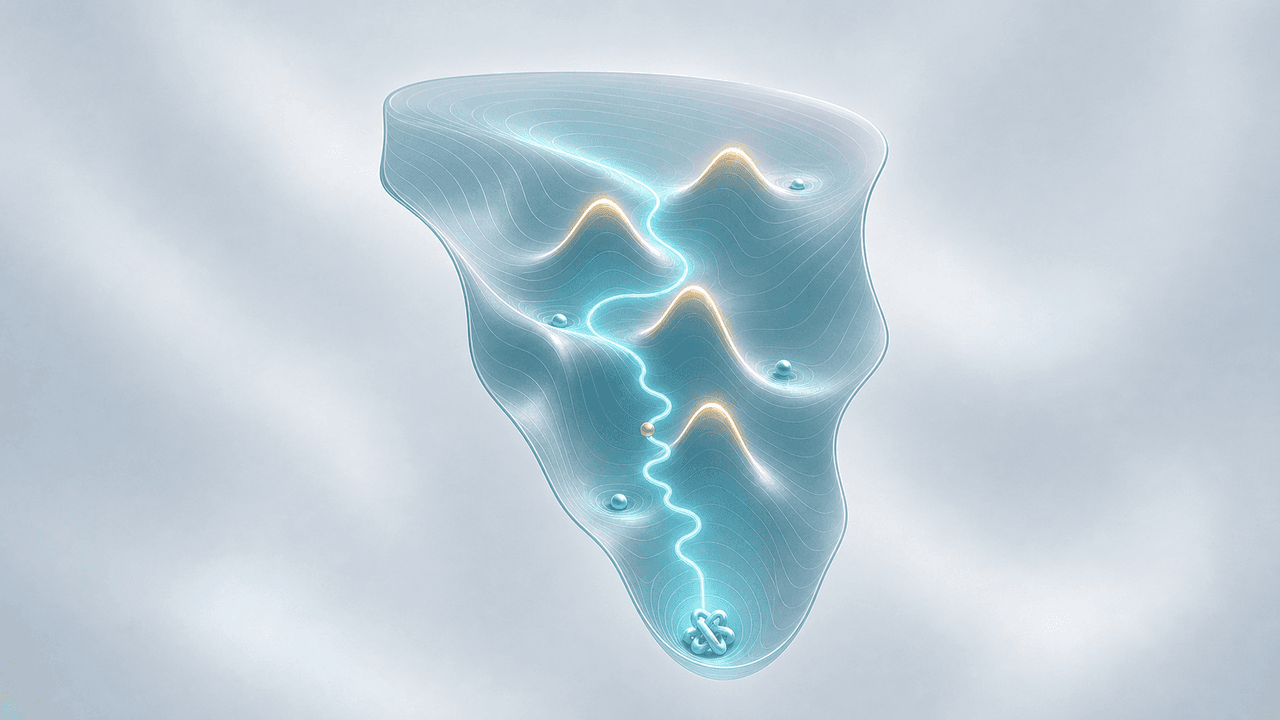
A landscape is a space, a value function, a neighborhood, and a search process.

The sequence starts simple, then adds interactions, ruggedness, neutrality, motion, constraints, multiple objectives, and incomplete knowledge.

Open unit
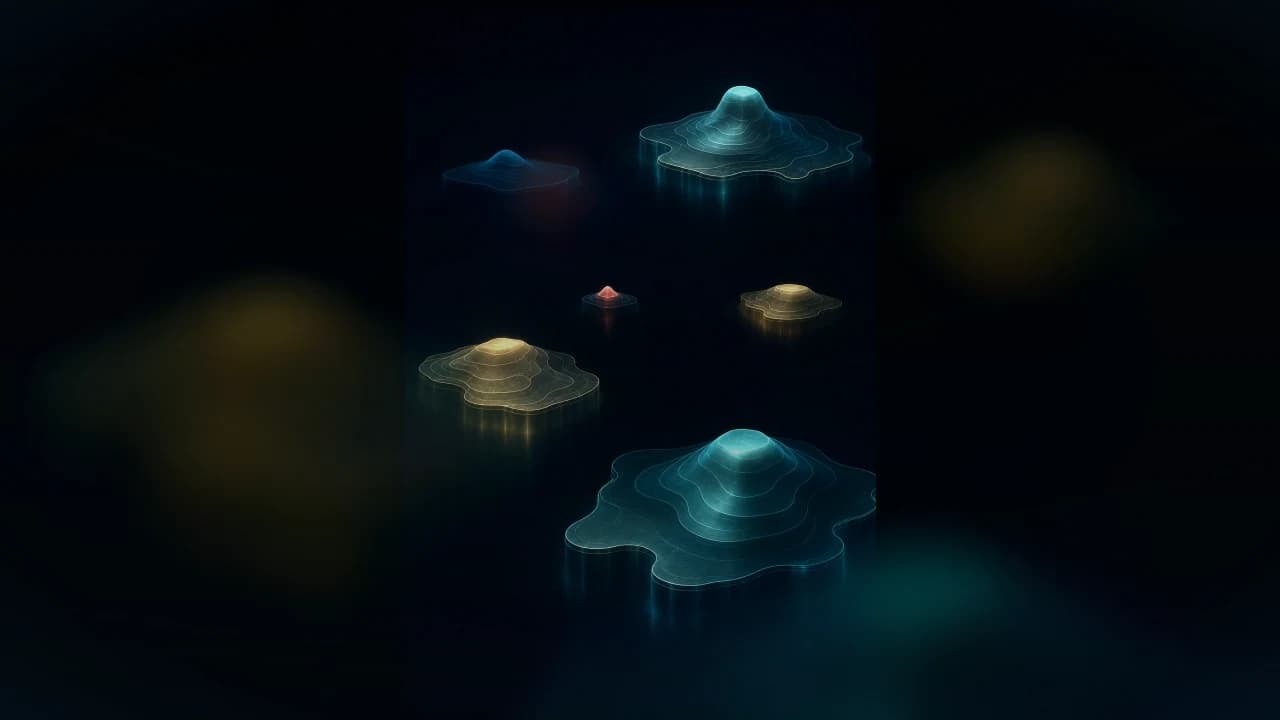
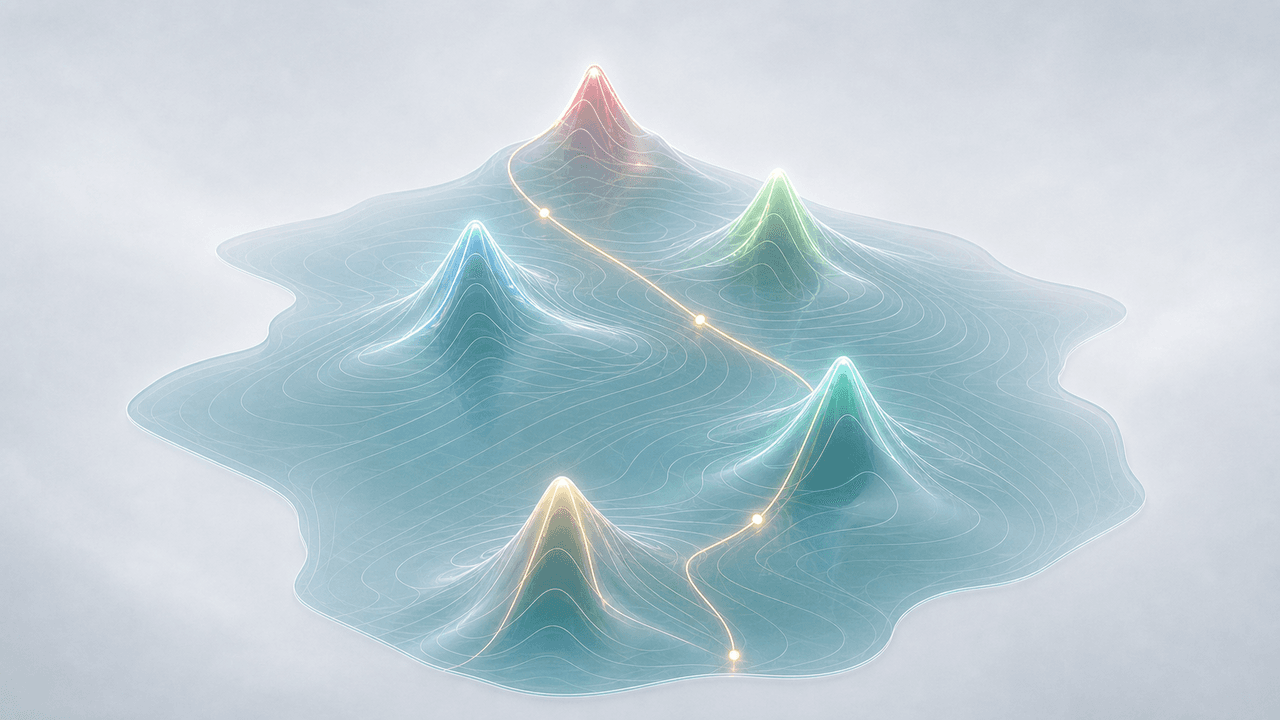
Adaptive landscape illustration with configuration points, contours, and search paths.Adaptive landscape illustration with configuration points, contours, and search paths.
Structure

The Basic Structure of Landscape Models

Every landscape model has four elements: possible states, the moves connecting them, a score for each state, and a search process. The first three define the terrain itself; the search process is separate, specifying how agents or algorithms move through it. This grammar is the shared scaffold every later model modifies.

60 minReader lesson

Open unit
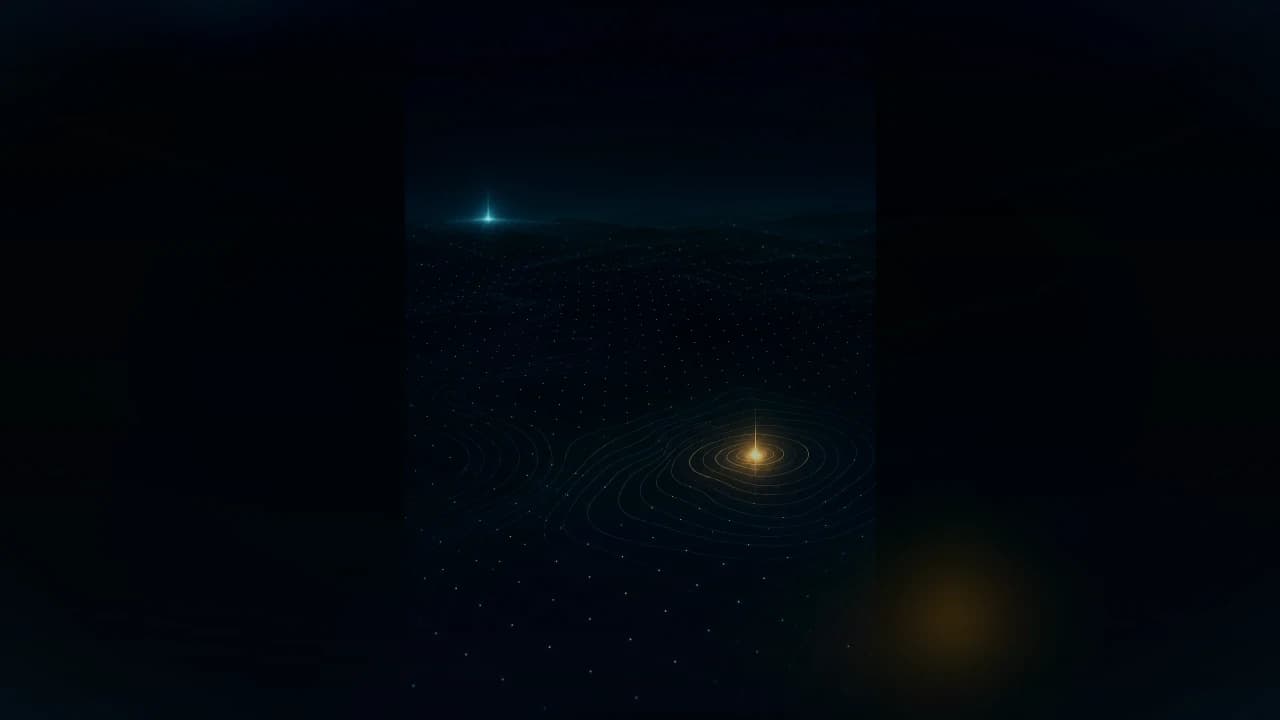
A toy binary configuration lattice lifts into a value surface with one search trace.A toy binary configuration lattice lifts into a value surface with one search trace.
Toy Model

Toy Coffee Fitness Landscape: Build a Complete Search Model

Build a complete landscape from scratch using coffee recipes as binary strings. Score all 32 configurations, define one-step neighborhoods, and run different walkers on the same terrain to see how epistasis, local peaks, and path dependence emerge from simple choices.

60 minReader lesson

Planned units in this course

Planned units

  • 03
    Adaptive landscape illustration for Mount Fuji Landscapes: Independent Parts Make One Smooth Climb.Adaptive landscape illustration for Mount Fuji Landscapes: Independent Parts Make One Smooth Climb.

    Mount Fuji Landscapes: Independent Parts Make One Smooth Climb

    The simplest landscape assumption: each component contributes to the total score independently, with no interactions between parts. In the additive, tie-free case, there are no suboptimal local peaks, so every improving step leads toward the single global optimum. This baseline is the starting point against which every later model measures what it adds.

    Planned / 60 min
  • 04
    Adaptive landscape illustration for Rough Mount Fuji Landscapes: A Smooth Trend Plus Local Roughness.Adaptive landscape illustration for Rough Mount Fuji Landscapes: A Smooth Trend Plus Local Roughness.

    Rough Mount Fuji Landscapes: A Smooth Trend Plus Local Roughness

    Adds random noise to Mount Fuji's smooth additive trend. A broad improvement direction still exists, but local bumps make nearby scores imperfect guides. Many measured molecular fitness landscapes appear intermediate in this way: a broad additive trend plus epistatic deviations, sitting between pure smoothness and pure randomness.

    Planned / 60 min
  • 05
    Adaptive landscape illustration for Rugged Landscapes: Interdependent Parts Can Create Local Traps.Adaptive landscape illustration for Rugged Landscapes: Interdependent Parts Can Create Local Traps.

    Rugged Landscapes: Interdependent Parts Can Create Local Traps

    Makes components interdependent: changing one part changes the value of others. When these interactions are strong enough to produce sign epistasis (where a change helps on one background and hurts on another), hill-climbing can get stuck on local peaks. This captures interdependence in biology, complementarities in organizations, and architectural coupling in technology.

    Planned / 60 min
  • 06
    Adaptive landscape illustration for N-K Landscapes: K Controls Coupling Between Parts.Adaptive landscape illustration for N-K Landscapes: K Controls Coupling Between Parts.

    N-K Landscapes: K Controls Coupling Between Parts

    Gives interdependence a tunable dial: N components with K dependencies each. In the standard random NK model, increasing K tunes expected ruggedness from additive, Fuji-like landscapes toward House-of-Cards-like uncorrelated landscapes. This lets you match the model to a specific system rather than treating ruggedness as all-or-nothing.

    Planned / 60 min
  • 07
    Adaptive landscape illustration for House-of-Cards Landscapes: Neighboring Scores Are Uncorrelated.Adaptive landscape illustration for House-of-Cards Landscapes: Neighboring Scores Are Uncorrelated.

    House-of-Cards Landscapes: Neighboring Scores Are Uncorrelated

    The extreme limit of ruggedness: neighboring configurations have uncorrelated scores. Hill-climbing still finds a local peak, but each local comparison gives almost no information about what lies beyond the immediate neighborhood. Search becomes purely myopic, offering little assurance of reaching a globally good solution, so strategies like random restarts, parallel exploration, or recombination become essential.

    Planned / 60 min
  • 08
    Adaptive landscape illustration for Needle-in-a-Haystack Landscapes: Success Is Rare, Not Misleading.Adaptive landscape illustration for Needle-in-a-Haystack Landscapes: Success Is Rare, Not Misleading.

    Needle-in-a-Haystack Landscapes: Success Is Rare, Not Misleading

    Introduces a different axis of difficulty from ruggedness: solutions exist but are vanishingly rare in a vast flat space. The challenge is sparsity rather than misleading peaks, and brute force fails because each added dimension multiplies the search space without adding gradient information.

    Planned / 60 min
  • 09
    Adaptive landscape illustration for Neutral Plateau Landscapes: Equal Scores Still Move Search.Adaptive landscape illustration for Neutral Plateau Landscapes: Equal Scores Still Move Search.

    Neutral Plateau Landscapes: Equal Scores Still Move Search

    Shows that flat regions of equal value are not dead ends. Sideways movement across a plateau can reposition a searcher so that new uphill moves become reachable, provided the plateau connects to those moves. Neutral drift in evolution and organizational slack in innovation illustrate how lateral steps open doors that pure optimization cannot.

    Planned / 60 min
  • 10
    Adaptive landscape illustration for Neutral Network Landscapes: Many Equal-Function States Stay Connected.Adaptive landscape illustration for Neutral Network Landscapes: Many Equal-Function States Stay Connected.

    Neutral Network Landscapes: Many Equal-Function States Stay Connected

    Extends neutral plateaus by connecting equal-value states into traversable networks. A system stays functionally stable while exploring many underlying configurations, creating robustness because many changes preserve function and evolvability because different network positions border different adaptive possibilities.

    Planned / 60 min
  • 11
    Adaptive landscape illustration for Holey Landscapes: Viability Replaces a Single Fitness Summit.Adaptive landscape illustration for Holey Landscapes: Viability Replaces a Single Fitness Summit.

    Holey Landscapes: Viability Replaces a Single Fitness Summit

    Replaces the idea of a single fitness summit with viable versus inviable regions. In high dimensions, viable states can form large connected networks around inviable holes without ever crossing a valley, provided the viable set is sufficiently connected. The question shifts from "how do I reach the peak?" to "how do I stay within the connected viable region?"

    Planned / 60 min
  • 12
    Adaptive landscape illustration for Fitness Seascapes: Fitness Landscapes Move Over Time.Adaptive landscape illustration for Fitness Seascapes: Fitness Landscapes Move Over Time.

    Fitness Seascapes: Fitness Landscapes Move Over Time

    Drops the assumption that the terrain holds still. The value function shifts as environments, therapies, or competitors change, so the best solution today may be harmful tomorrow. A "dancing landscape" in Scott E. Page's sense, where search must track a moving target rather than converge on a fixed summit.

    Planned / 60 min
  • 13
    Adaptive landscape illustration for Coevolutionary Landscapes: Other Agents Move Your Terrain.Adaptive landscape illustration for Coevolutionary Landscapes: Other Agents Move Your Terrain.

    Coevolutionary Landscapes: Other Agents Move Your Terrain

    Where seascapes model exogenous landscape change (environments shift from outside), coevolutionary landscapes make the change endogenous: other agents' adaptations reshape your terrain, so optimization pursues a target that moves because you moved. Another "dancing landscape," driven from within by the Red Queen dynamic of mutual adaptation.

    Planned / 60 min
  • 14
    Adaptive landscape illustration for Energy Landscapes: Lower Energy Means Greater Stability.Adaptive landscape illustration for Energy Landscapes: Lower Energy Means Greater Stability.

    Energy Landscapes: Lower Energy Means Greater Stability

    Maps the landscape framework to physics by inverting the value direction: lower energy means greater stability. In protein folding, the canonical example, this means lower free energy under specified conditions. A rugged funnel biases the chain toward its native structure, but kinetic barriers determine whether it can get there, so accessibility matters as much as optimality.

    Planned / 60 min
  • 15
    Adaptive landscape illustration for Attractor Landscapes: Basins Pull Systems Toward Stable States.Adaptive landscape illustration for Attractor Landscapes: Basins Pull Systems Toward Stable States.

    Attractor Landscapes: Basins Pull Systems Toward Stable States

    Maps the framework to dynamical systems: basins replace peaks, ridges become tipping thresholds, and the question shifts from "where is the summit?" to "which basin are we in, how deep is it, and what shock would tip us into a different regime?" Sometimes the landscape is a true potential function; sometimes it is a visualization of basin structure. Lakes, ecosystems, and social systems all exhibit this basin-and-tipping pattern.

    Planned / 60 min
  • 16
    Adaptive landscape illustration for Waddington Landscapes: Development Follows Constrained Branches.Adaptive landscape illustration for Waddington Landscapes: Development Follows Constrained Branches.

    Waddington Landscapes: Development Follows Constrained Branches

    Maps the framework to developmental biology by adding progressively constrained branching. A cell moves through narrowing channels shaped by gene regulation, where each fork makes alternatives increasingly hard to reverse. Canalization constrains which futures remain reachable. Modern single-cell data connects Waddington's metaphor to measurable gene regulatory attractors.

    Planned / 60 min
  • 17
    Adaptive landscape illustration for Loss Landscapes: Neural Network Parameters Form the Terrain.Adaptive landscape illustration for Loss Landscapes: Neural Network Parameters Form the Terrain.

    Loss Landscapes: Neural Network Parameters Form the Terrain

    Maps the framework to machine learning: each point is a set of neural network parameters, height is loss (the quantity being minimized, so the goal is a valley rather than a summit), and optimizers navigate a high-dimensional surface of flat minima, sharp minima, and saddle points. The solution found depends on optimizer, initialization, data, and architecture in ways that earlier landscape intuitions help explain.

    Planned / 60 min
  • 18
    Adaptive landscape illustration for Pareto Landscapes: Multiple Objectives Create a Frontier.Adaptive landscape illustration for Pareto Landscapes: Multiple Objectives Create a Frontier.

    Pareto Landscapes: Multiple Objectives Create a Frontier

    Drops the assumption of a single objective. When multiple goals apply simultaneously, there is no single summit. The Pareto frontier describes the set of nondominated solutions where no objective can be improved without worsening at least one other; away from the frontier, some moves may improve multiple objectives at once. The tradeoff structure matters for engineering, policy, medicine, and AI alignment.

    Planned / 60 min
  • 19
    Adaptive landscape illustration for Unknown Landscapes: Search Learns a Terrain From Samples.Adaptive landscape illustration for Unknown Landscapes: Search Learns a Terrain From Samples.

    Unknown Landscapes: Search Learns a Terrain From Samples

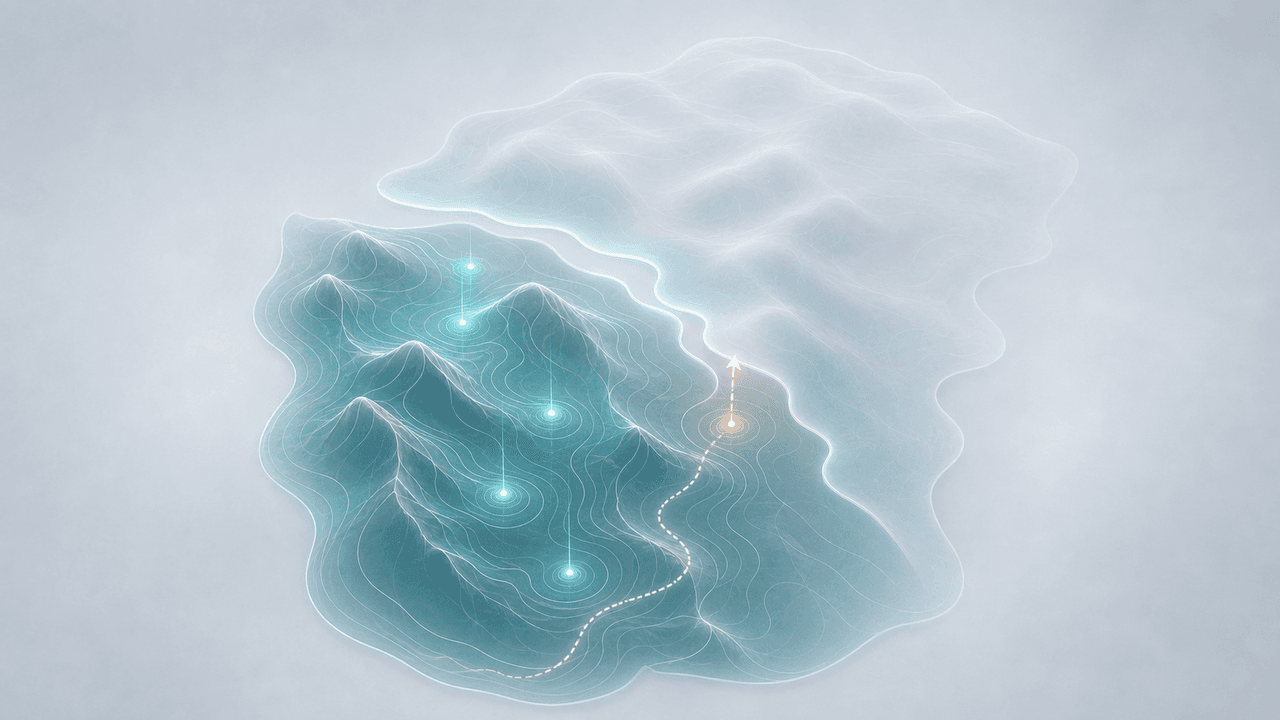
    Drops the assumption that the searcher knows the full value function. In practice, we observe only a tiny sample and must infer the terrain from those observations. Good search balances exploiting what looks promising with exploring regions of high uncertainty. Bayesian optimization, active learning, and ML-guided directed evolution make this concrete.

    Planned / 60 min
Thomas Meli