Purpose from Feedback Alone
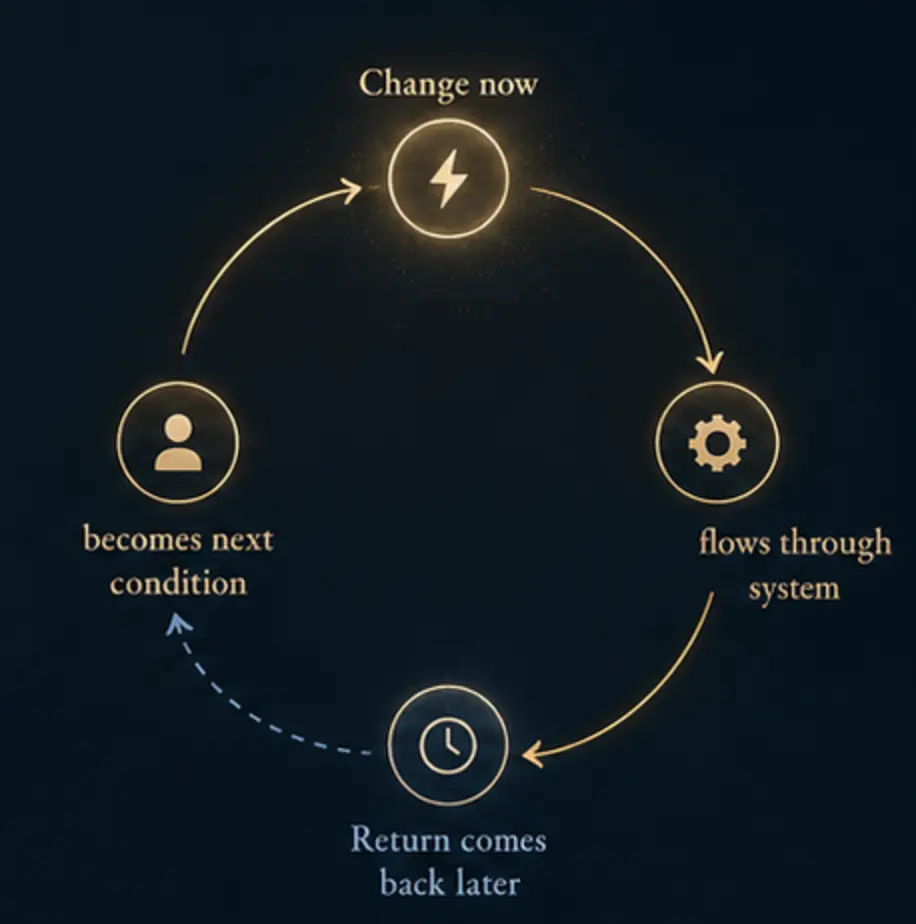
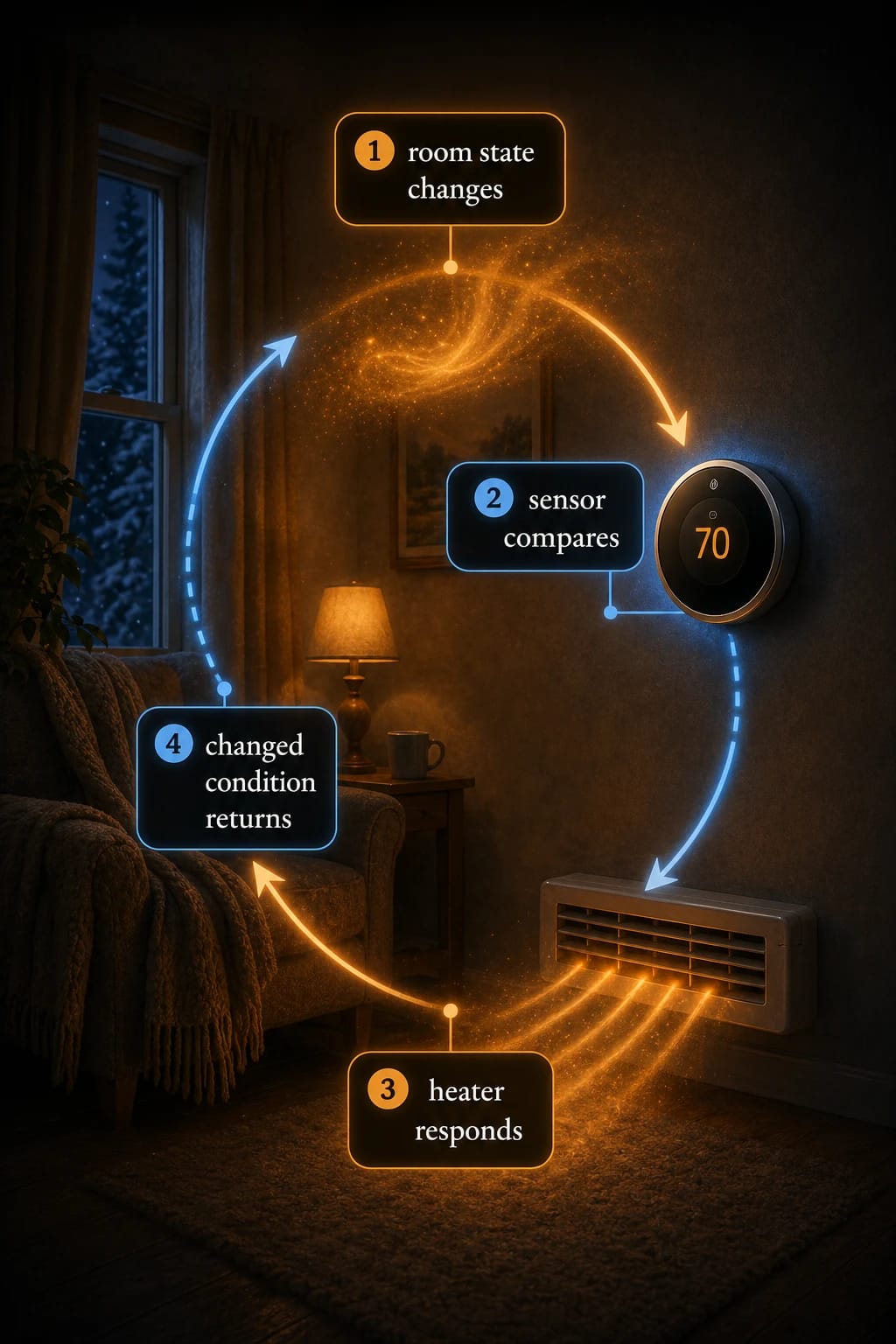
Twentieth-century systems science formalized a claim that had been circling philosophy for decades: purposeful behavior does not require a soul. It requires feedback. A system is goal-directed whenever its output is continuously measured against a target and the discrepancy between them is used to adjust its future output. That is all purpose needs to be. A thermostat has purpose. A missile has purpose. A fly moving toward a lamp has purpose.
This formalization came out of a wartime engineering problem. In 1942, Norbert Wiener, physiologist Arturo Rosenblueth, and engineer Julian Bigelow were working on antiaircraft fire control at MIT. To hit a moving target, the gun had to predict where the plane would be, not where it was. That meant modeling the pilot's behavior, projecting a probable future trajectory, and correcting continuously as the pilot responded, swerved, climbed. The gun and the plane were locked inside each other's logic. Neither was simply acting. Both were reacting, anticipating, updating. Their 1943 paper, "Behavior, Purpose and Teleology," published in Philosophy of Science, announced that the metaphysical question of what goals really are dissolves into an engineering question about the structure of the loop. Feedback was flexible enough to cross every border: machine, animal, mind, society. [10]Citation 10
The structure is easier to see with numbers. A room is at 72°F. The thermostat's target is 68°F. The error is +4°F, and the system cools at a rate proportional to the error. After one cycle the room reaches 70°F. Now the error is only +2°F, so the correction weakens. Next cycle: 69°F. Then 68.5°F. Each correction is smaller because the discrepancy that drives it is smaller. The loop does not push with constant force. It responds to its own effect. That is the signature of feedback: the output reshapes the input to the next round.
A dam develops a small crack. Water seeps through, eroding the crack wider, which lets more water through, which erodes faster. Is this feedback or a one-directional chain?
The erosion widens the crack, which increases the water flow, which increases the erosion. The output of one round becomes the input to the next. That circular structure is the signature of feedback, specifically reinforcing feedback, where the process amplifies its own conditions. A one-directional chain would look like a domino sequence: A causes B causes C, with no return path from C back to A.
Nested Loops: The Architecture of Adaptation
Negative feedback corrects. But correction is not enough for genuine adaptation, and the distinction matters enormously. A system that only corrects deviations from a fixed target cannot change what it considers a viable target when the world no longer cooperates. That incapacity is not a minor limitation. It is the difference between regulation and learning, between a thermostat and a living organism.
William Ross Ashby came to this problem through psychiatry, working first at Leavesden Mental Hospital in Hertfordshire and later at St Andrew's and Barnwood House, where the homeostat was completed in 1948. The machine was made of four interconnected units that could change their internal settings when essential variables drifted outside viable limits. When ordinary negative feedback failed, it did not simply fail. It searched through new configurations until it found an arrangement that worked. Ashby called this ultrastability: the idea that a truly adaptive system needs not one feedback loop but two, nested, where a higher-order loop changes the corrective machinery itself when correction repeatedly fails. The clinical insight and the engineering device were the same thought in different materials. [11, 12]Citation 11, 12
His 1956 "An Introduction to Cybernetics" introduced the concept of requisite variety, feedback's fundamental constraint: a regulator needs enough effective variety to absorb the variety of disturbances that would otherwise reach the regulated variable. This is subtler than a one-to-one counting rule. The thermostat from the previous section has two states, on and off, yet it handles a continuous range of temperature disturbances, because the building's thermal mass dampens most of the variation before it reaches the controlled variable. The loop must be rich enough to keep the outcome within bounds, and good system design can reduce how much variety the regulator itself has to carry. [11]Citation 11
Ashby studied zoology at Sidney Sussex College, Cambridge, then medicine at St Bartholomew's Hospital in London, and chose psychiatry because the brain interested him more than the body. From 1928 until his death in 1972 he kept a detailed intellectual journal, eventually filling twenty-five handwritten volumes with circuit diagrams, self-addressed questions, and incremental refinements of ideas about adaptation and stability. The homeostat he built from war-surplus parts in 1948 was the physical realization of years of those journal entries: a machine that could reorganize its own wiring when its environment shifted beyond the range of ordinary correction. [11, 12]Citation 11, 12
A home thermostat keeps the room at 68°F. An animal migrates south when winter makes its usual habitat unviable. What is the key structural difference?
The thermostat has one loop: measure error, correct toward 68°F. When the target itself becomes unworkable, the thermostat has no response. The migrating animal effectively changes its target environment, switching from one set of viable conditions to another. That is Ashby's ultrastability: a second, higher-order loop that reorganizes the system's goals when first-order correction repeatedly fails. The biological/mechanical distinction is not the relevant one here; what matters is the number of nested feedback levels.
The Observer Inside the Loop
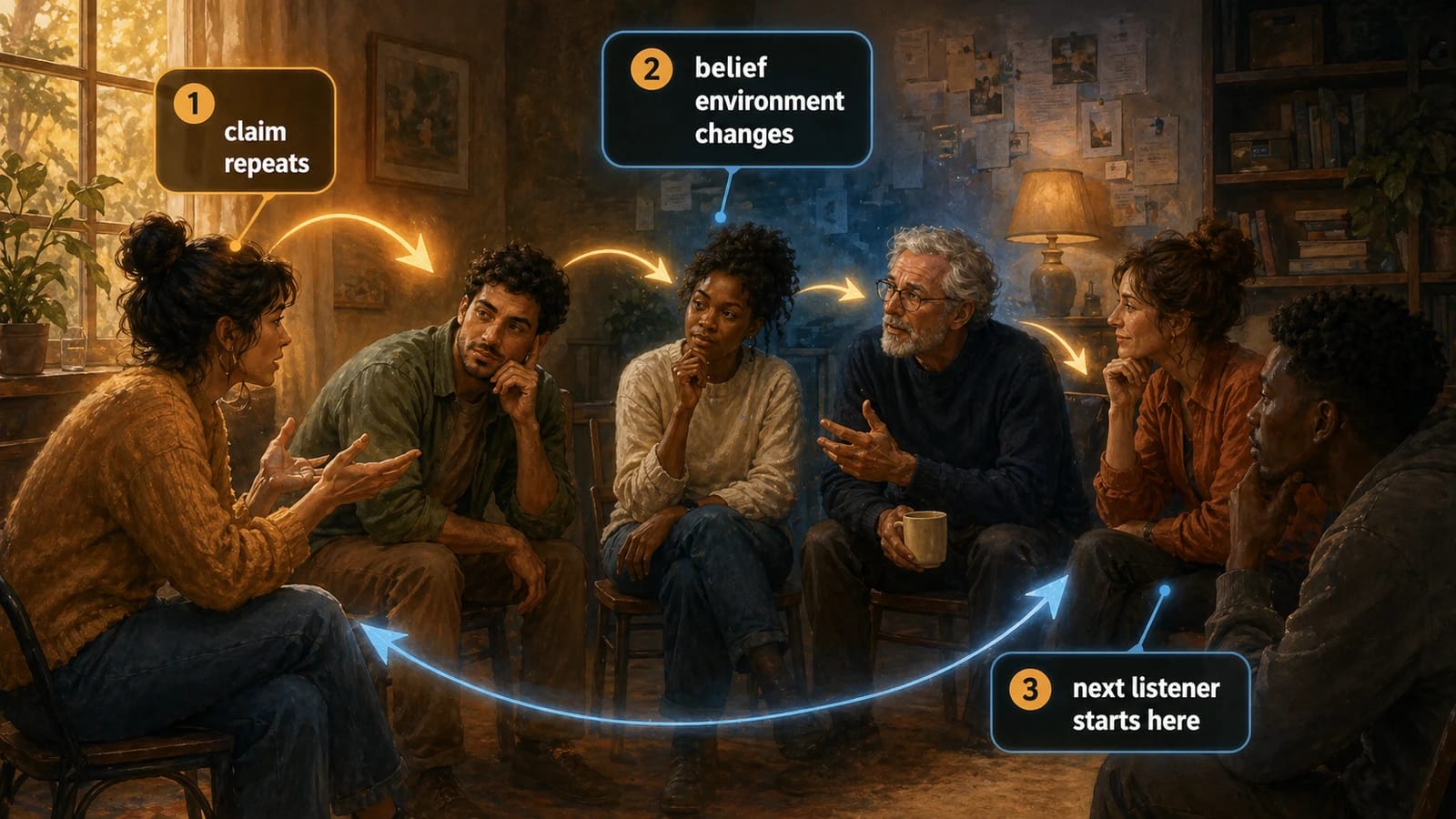
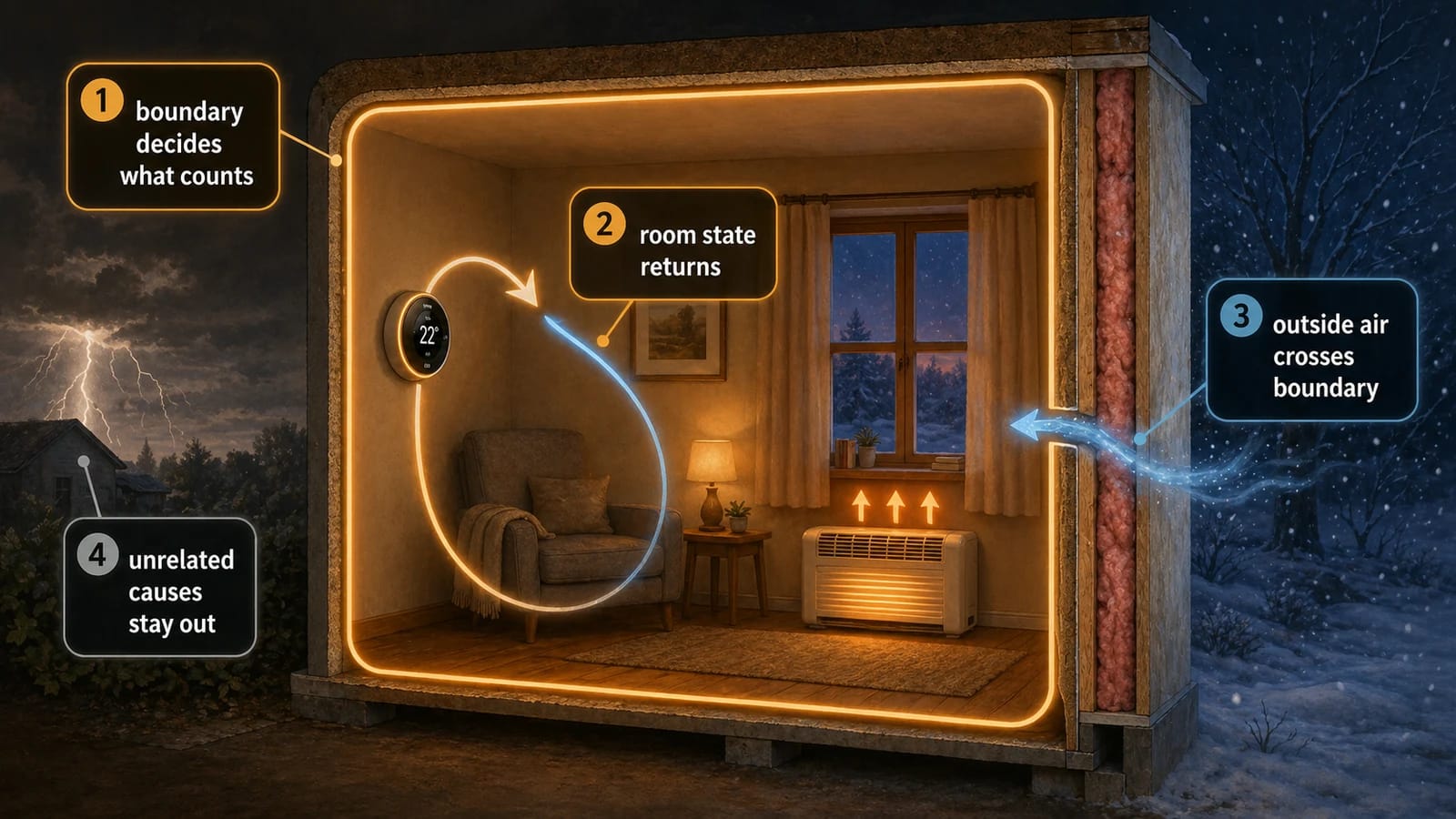
Ashby's nested loops take the system boundary as given: essential variables are specified, and the homeostat works within that specification. But where you draw the boundary changes what counts as feedback. This is not a semantic technicality. It is a structural fact with real consequences.
Heinz von Foerster made this precise in a 1959 address titled, provocatively, "There Are No Such Things as Self-Organizing Systems." His argument was thermodynamic: a local decrease in entropy has to be paid for by increased entropy somewhere else in the larger system. Therefore, a system that appears to spontaneously increase its own organization is not pulling itself up by its bootstraps but drawing energy, order, or usable constraint from an environment with which it remains coupled. Self-organization is always, in some precise sense, environment-assisted. The environment is inside the concept, not behind it. [13]Citation 13
Von Foerster called the inverse phenomenon "order from noise": perturbations from outside, rather than degrading a system, can under the right conditions become the material from which new order is built. The trick is that the system must be structured so that it can exploit randomness, using noise as a resource rather than merely suffering it as interference. This is not a creation-from-nothing claim. The structure that channels noise into order is itself a product of prior evolutionary, developmental, or physical history. The point is narrower: once such structure exists, randomness becomes a resource rather than purely a degradation.
He spent three decades at the Biological Computer Laboratory at the University of Illinois extending this into epistemology and cognition, arriving at a second-order cybernetics, a cybernetics of cybernetics, in which the observer cannot be extracted from the description of what is observed. The structure of the feedback relationship between an observing system and its environment is part of what determines what counts as signal, noise, order, and disturbance. You cannot describe a loop without having already made decisions, usually implicit, about where the boundary is drawn. [13]Citation 13
Von Foerster grew up in Vienna, trained as a physicist, and survived the war working on radar technology in Germany. He arrived in the United States in 1949 with limited English and a manuscript on memory that caught the attention of Warren McCulloch, who invited him to the Macy Conferences on cybernetics as their youngest participant and, soon after, their editor. He ran the Biological Computer Laboratory at the University of Illinois for nearly three decades with a style colleagues described as relentlessly Socratic, preferring questions that unsettled assumptions to answers that settled them. [13]Citation 13
Positive Feedback and the Thermodynamics of Structure
Standard thermodynamics describes isolated systems moving toward maximum entropy, toward disorder, toward equilibrium. But a great deal of what is interesting in nature violates the spirit of that picture. The resolution is that living systems are not isolated. They are open, far from equilibrium, continuously importing energy, and it is precisely this openness that allows them to maintain and generate structure rather than dissolve into it.
In 1900, Henri Bénard heated a thin layer of fluid from below and watched it self-organize into a regular pattern of hexagonal cells, each one a coherent circulation of rising and sinking fluid. Later analysis showed that surface-tension gradients were central to Bénard's particular shallow-layer arrangement, while the standard teaching version of the phenomenon, Rayleigh–Bénard convection, is driven by buoyancy in deeper fluid layers. The thermodynamic lesson survives the distinction: the ordered pattern exists because energy continuously flows through the system. Stop the heating, and the cells collapse.
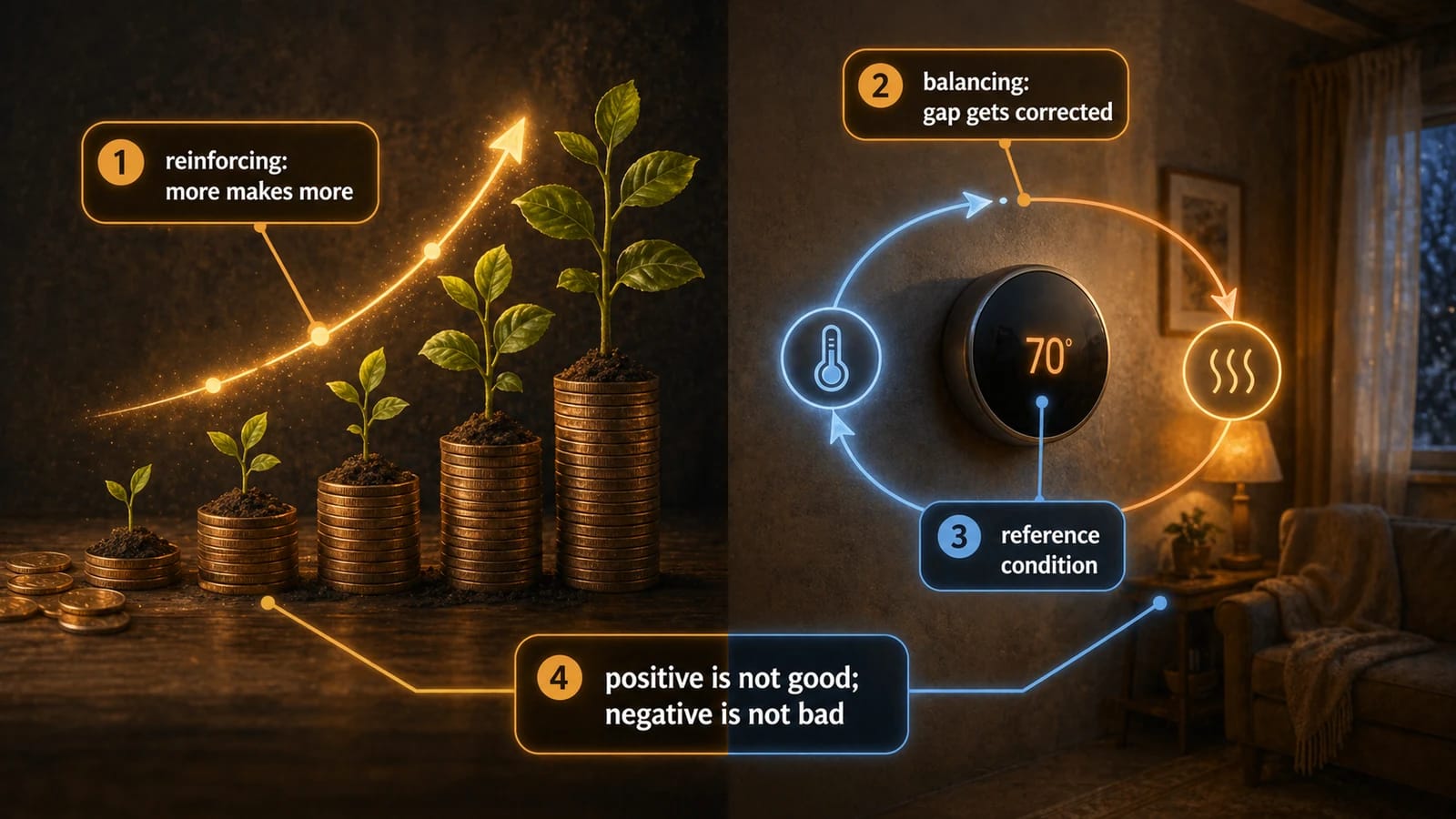
Ilya Prigogine, who won the 1977 Nobel Prize in Chemistry for nonequilibrium thermodynamics, gave this class of phenomena a general language: far from equilibrium, fluctuations that would be damped near equilibrium can instead be amplified into new ordered regimes. This is positive feedback doing the opposite of what negative feedback does: instead of correcting deviations, it amplifies them, and the amplified deviation can become the new structure. Negative feedback maintains. Positive feedback transforms. What Prigogine called dissipative structures, ordered configurations sustained by continuous energy throughput, exist across many scales: convection cells, chemical oscillations, metabolism, hurricanes, ecosystems, cities. The fluctuation is not always the enemy of the structure. Sometimes it is the seed. [14]Citation 14
Ice forms on a lake surface. The ice insulates the water below, slowing further cooling, so the deeper water stays liquid longer. What type of feedback is this?
The ice insulates, which reduces heat loss from the water below, which slows further ice formation. The process partially counteracts itself. That is balancing feedback: the output works against the conditions that produced it. Reinforcing feedback would look like the opposite: thin ice cracking under stress, exposing warm water that melts adjacent ice, widening the crack. Same physical system, different feedback polarity, depending on which process you trace.
The Loop That Produces Itself
Prigogine's dissipative structures show that energy flow can sustain order. Biology adds a sharper question: what kind of feedback organization makes a system continuously produce the very components it needs to keep producing them? A convection cell is maintained by energy flow, yet the hexagonal pattern does not manufacture the fluid molecules that carry it. Living systems close that gap: the cell produces the enzymes and membranes that allow the cell to produce the enzymes and membranes. The feedback loop produces the machinery that runs the feedback loop.
Humberto Maturana and Francisco Varela formalized this in the early 1970s with the concept of autopoiesis, from the Greek for self-production. A cell's metabolic network generates lipids, proteins, and membrane structures. Those structures create the bounded volume within which the metabolic network operates at concentrations high enough to sustain itself. The output of the process is the precondition for the process. Remove the membrane and the reactants disperse; remove the metabolic network and the membrane degrades. Neither component is prior. Both sustain each other through continuous circular production. [15]Citation 15
This is a qualitatively different kind of feedback from what the preceding sections describe. A thermostat's loop corrects toward a fixed reference signal. Ashby's ultrastable loop changes the reference when correction fails. In autopoiesis, there is no external reference signal. The "target" is the continuation of the organization itself. The loop regenerates the physical substrate that keeps it running. Maturana and Varela called this organizational closure: a network of production processes in which every component participates in producing the others and the boundary that defines the system as a unit. What distinguishes living from nonliving, on this account, is the topology of the feedback: circular production that regenerates its own conditions of existence. [15]Citation 15
Maturana studied medicine in Santiago and then biology at University College London and Harvard, where the frog retina work with Lettvin and McCulloch began. He returned to Chile in 1960 and spent the rest of his career at the University of Chile, building a research group in the biology of cognition while the country went through decades of political upheaval around him. The concept of autopoiesis emerged from long conversations with his student Francisco Varela during the early 1970s, as both men tried to answer a question Maturana considered fundamental: what is the organization that makes a living thing alive rather than merely chemical? [15, 16]Citation 15, 16
Hierarchy and the Time Problem of Complexity
Given enough time and enough variation, feedback between organisms and environments can produce extraordinary complexity. But "enough time" is not free. The space of possible configurations can grow combinatorially with the number of components, and unguided search through that space becomes implausible unless evolution can preserve useful intermediate structures and reuse partial solutions. This is not a creationist argument. It is a search-space constraint, and it points toward a structural property that makes complexity more achievable.
In 1962, Herbert Simon offered the clearest account of that property in "The Architecture of Complexity." The argument pivoted on a parable about two watchmakers. Tempus assembled watches of a thousand parts in a single continuous sequence: any interruption meant starting over. Hora assembled his in a hierarchical sequence of stable subassemblies, ten parts forming a stable module, ten modules forming a larger module, ten of those forming a complete watch. If interrupted, Hora lost at most one subassembly. Hierarchy is not necessarily imposed on complex systems by an external designer; stable intermediate forms can make complex systems much easier to evolve, repair, and analyze. Stable intermediate forms reduce the search problem dramatically, because each level can preserve workable partial solutions rather than navigating the full configuration space of the whole at once. [6]Citation 6
The feedback logic embedded in this is subtle but important. Within a module, feedback loops are dense and fast. Across modules, coupling is weaker and slower. This asymmetry between scales is what makes the whole system tractable. If every component were equally tightly coupled to every other component, disturbances would propagate everywhere instantly, and no level would have room to find its own stability. The apparent looseness between levels is not inefficiency. It is what gives each level room to adapt, and what limits the cascade of failure when one part of the system goes wrong.
Two teams build identical 1,000-piece structures. Team A builds in stable 10-piece modules. Team B builds as one continuous assembly. Both face random interruptions every few minutes. After many hours, what happens?
This is Simon's watchmaker parable. Team B loses all progress with each interruption. Team A loses at most one 10-piece module. The difference is dramatic: if interruptions are frequent enough, Team B may never finish at all, while Team A's expected completion time grows only modestly with interruption rate. Stable intermediate structures protect accumulated progress from catastrophic loss, which is why hierarchical, modular organization is easier to evolve, repair, and scale.
Complexity Against Stability
The intuition that more complexity means more robustness is intuitively appealing and, as a general principle, wrong. The relationship between connectivity and stability in complex systems is not positive and linear but conditional and nonlinear, governed by the distribution of feedback loop signs and the strength of coupling across the system's interaction structure.
Robert May demonstrated this in 1972 with a deceptively clean mathematical argument. The prevailing view in ecology held that diverse, richly connected food webs were more stable than simple ones. May analyzed the eigenvalues of random interaction matrices and showed that above a certain combination of system size, connectance, and average interaction strength, random coupling overwhelms local self-damping and the equilibrium becomes unstable. The lesson was narrower and sharper than "complexity is bad": random increases in connection density and interaction strength can undermine stability even when every part is locally regulated. [17]Citation 17
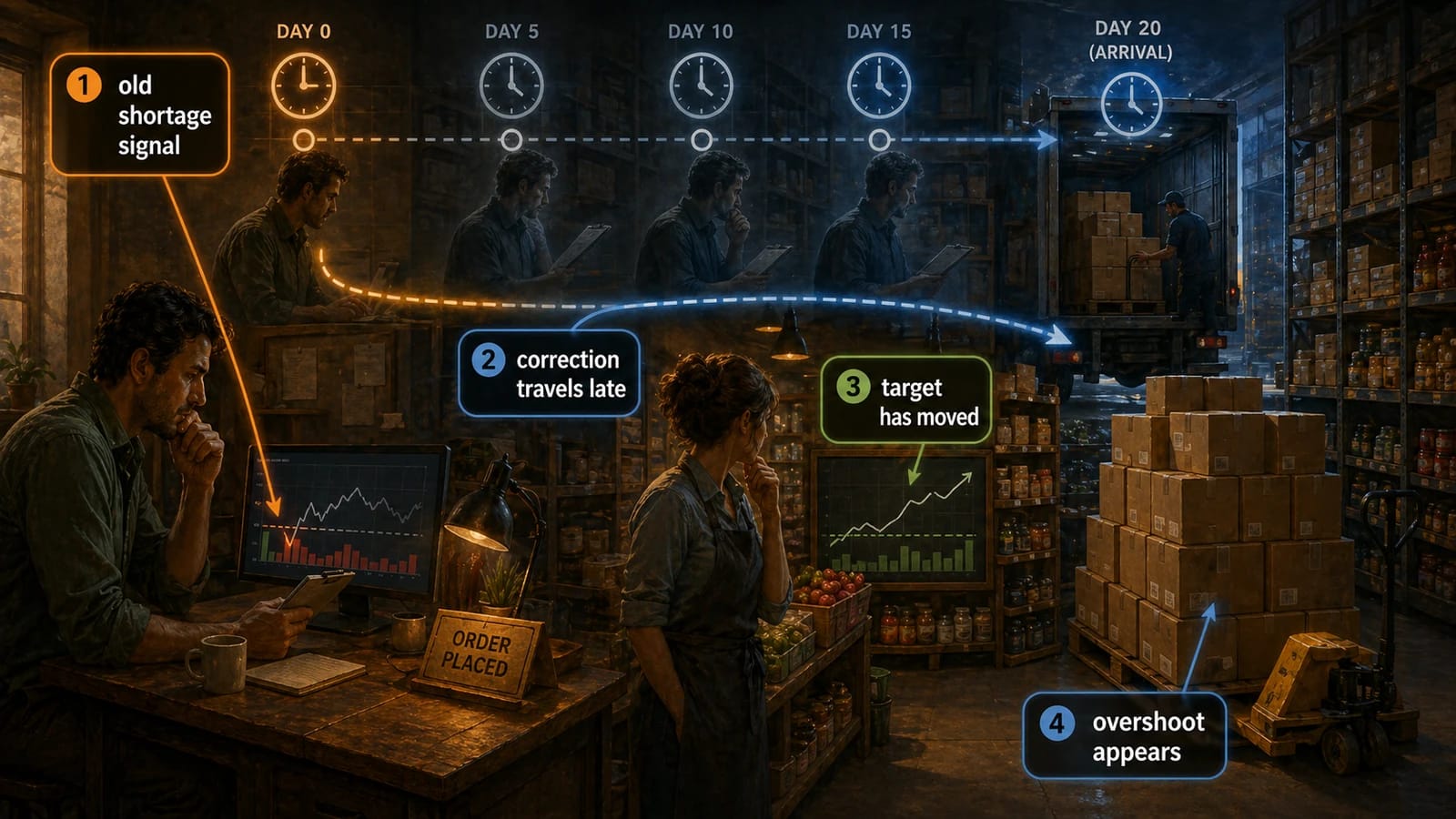
May's 1976 follow-up used the simplest possible discrete model to show how feedback gain alone determines whether a loop stabilizes, oscillates, or becomes unpredictable: the logistic map, x_{t+1} = r \cdot x_t(1 - x_t). The next generation's population is this generation's population multiplied by the remaining unused capacity, scaled by a growth parameter r. The term (1 - x_t) is saturation: as the population fills its capacity, the return signal weakens. At moderate r, the system converges to a steady level. But when correction arrives too hard and too fast relative to the system's inertia, overshoot is inevitable. The system tries to correct, overshoots, corrects again, overshoots again, and at sufficiently high gain the trajectory never repeats. [18]Citation 18
The feedback mechanism does not change. What changes is the ratio between the strength of the correction and the speed of the system's update cycle. Oscillation is a feedback behavior in its own right: the loop is strong enough to overshoot but not so strong that the pattern dissolves into unpredictability. And saturation constrains the overshoot, keeping it bounded. The broader lesson is structural: stability, oscillation, and unpredictability are three behaviors of the same return path, separated only by how aggressively the loop corrects relative to the pace of change.
May trained in theoretical physics in Sydney, earned his doctorate in superconductivity, and then turned to population biology because the mathematical structures interested him and the ecological questions were, in his view, underserved by quantitative rigor. His 1972 Nature paper was two pages long and overturned a generation of ecological intuition about the relationship between diversity and stability. He went on to serve as Chief Scientific Adviser to the UK government and President of the Royal Society, but the work that altered the field most came from applying the tools of one discipline to the unexamined assumptions of another. [17]Citation 17
A population with density-dependent crowding feedback is stable at moderate growth rate. You increase the growth rate substantially while keeping the same feedback mechanism. What happens?
The feedback mechanism is unchanged: crowding pushes the population down when it exceeds capacity. At moderate growth, correction is gentle enough to converge. At higher growth, the same correction overshoots the target, pulls back too far, and overshoots again. The result is persistent oscillation. This is the signature of excessive gain in a feedback loop: the correction itself becomes the source of instability. At even higher growth rates, the oscillation pattern can become so complex that the trajectory never settles into a simple repeating cycle.
Lock-In and Path Dependence
Reinforcing feedback does not always produce runaway growth. Under certain structural conditions, it produces something subtler and harder to reverse: lock-in, where an early advantage becomes self-perpetuating because each cycle of the loop increases the cost of switching to an alternative. The system does not explode. It commits.
W. Brian Arthur formalized this in the late 1980s by studying technology adoption under increasing returns. In classical economic models, markets converge toward the best available option because returns diminish as any one technology saturates. Arthur showed that when returns increase with adoption, a different logic takes over: the technology that gains an early lead attracts more users, more complementary investment, more infrastructure, and more learning, which increases its lead further. The loop is reinforcing, and the reinforcement accumulates in the structure around the technology rather than in the technology itself. Small historical accidents in the early period, who adopted first, which standard arrived at which conference, can determine which technology dominates for decades. [19, 20]Citation 19, 20
Arthur studied operations research in Belfast, earned his doctorate at Berkeley, and spent the 1980s at Stanford and the Santa Fe Institute developing a formal account of increasing returns and path dependence. The core papers were rejected by several journals before publication, in part because the result implied that markets could lock into inferior technologies without any failure of individual rationality. The conclusion was structural: when feedback is reinforcing and adoption builds its own infrastructure, the sequence of early events constrains later possibilities in ways that no amount of later optimization can undo. [19]Citation 19
Path dependence names the consequence: the system's current state carries the weight of its history, and earlier choices narrow later ones. A technology standard adopted early builds an ecosystem of training, tooling, and complementary products. A regulatory framework shapes the incentives that shape the next generation of firms. A city's street grid, once paved and built upon, constrains transportation options for centuries. The cost of reversal grows with each cycle of the reinforcing loop, until switching becomes practically impossible even when superior alternatives exist.
Lock-In A state in which reinforcing feedback has made an early commitment self-perpetuating. The cost of switching grows with each cycle, and the system persists in its historical path even when alternatives are available.
A social media platform gains early users, which attracts content creators, which attracts more users, which attracts advertisers, which funds features that attract still more users. After five years a technically superior competitor launches but struggles to gain traction. Is the original platform's dominance an example of lock-in or simple quality advantage?
Each cycle of the loop builds infrastructure, content libraries, social connections, and advertiser relationships that make switching costly for every participant. The question is not whether the platform is good. The question is whether the accumulated ecosystem makes departure expensive independent of quality. That structural irreversibility is lock-in. Network effects are the specific mechanism of reinforcing feedback operating here, and lock-in is the result when that feedback accumulates enough switching cost.
The distinction from earlier sections is important. Reinforcing feedback can amplify a signal until it saturates, crashes, or is counteracted. Lock-in is what happens when reinforcing feedback accumulates structural commitments rather than amplifying a single variable. The loop does not run away. It hardens. And path dependence means the hardened state carries its history forward as a constraint on what the system can become next. [20]Citation 20
Reading the Loop from Data
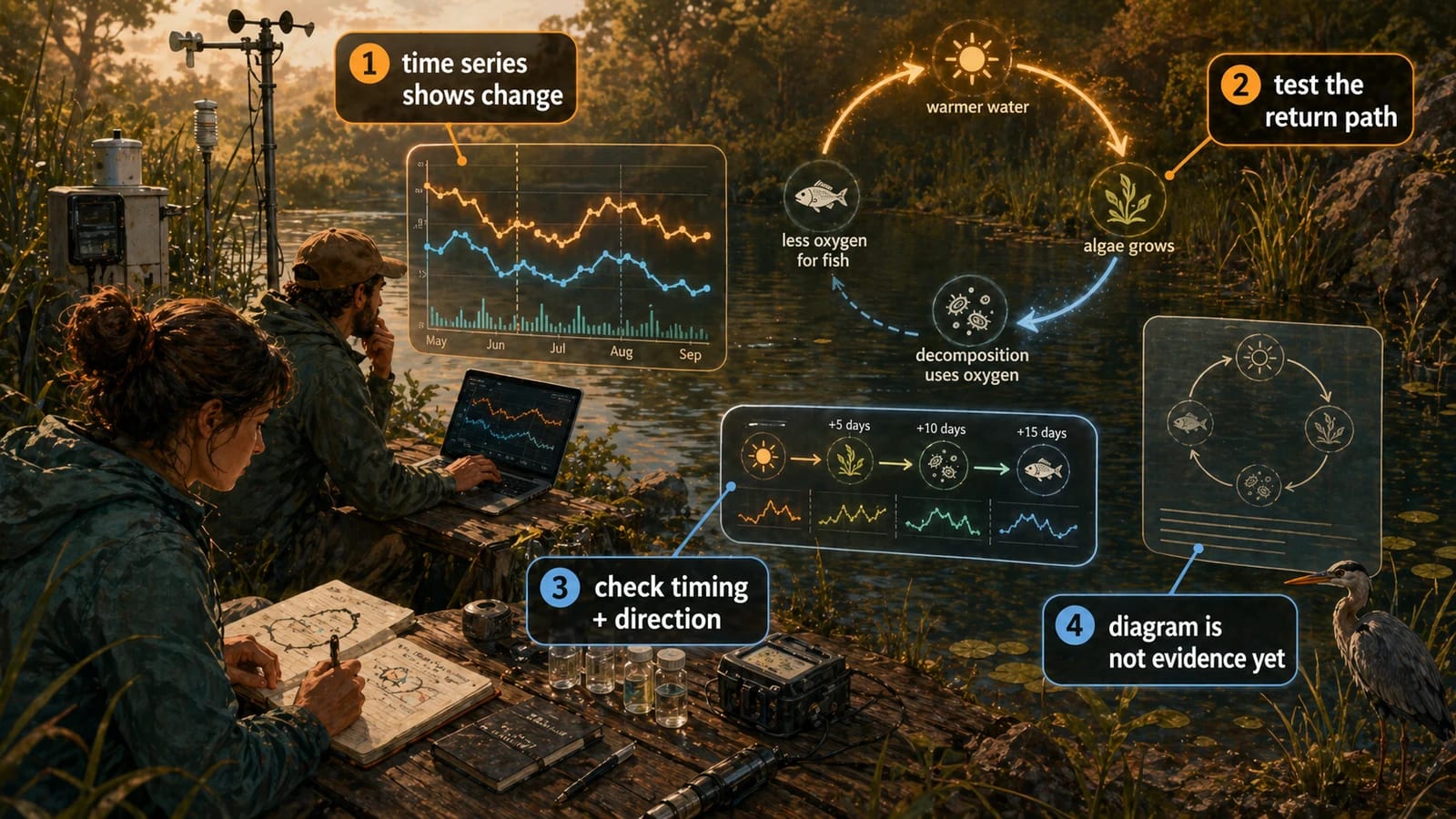
In many ecological and social settings, identifying feedback loops long depended on theory, intuition, and fitted diagrams. You proposed a plausible loop and checked whether it made sense against the data. When left at that level, the question of whether the loops were actually there, with what sign, what delay, what gain, was largely deferred to the judgment of experts. A loop diagram becomes causal reasoning only when it names the assumptions and evidence that could distinguish a real return path from common causes, indirect paths, or coincidence.
By the time feedback researchers began asking how to read loop structure from time-series data, causal inference already had a serious technical lineage. The Neyman-Rubin potential-outcomes tradition made causal effects counterfactual quantities rather than correlations; Pearl's structural causal models and do-calculus made identification depend on explicit graphical assumptions; and Spirtes, Glymour, and Scheines developed causal-discovery methods for recovering structure from conditional independencies. Sugihara's 2012 convergent cross mapping did not start rigorous causal identification from observational data. It contributed a specialized tool for one hard corner of the problem: coupled nonlinear dynamical systems where correlation can actively mislead. [22-26]Citation 22-26
In such systems, two variables can be tightly correlated without one causing the other, and correlation can vanish between variables that are strongly causally coupled. The key insight is that if two variables are genuinely coupled in a dynamical system, the history of one variable's behavior should contain information about the other's attractor. By testing whether reconstructed attractor geometry can predict across variables, and checking whether predictive skill increases with the length of the time series used, researchers can infer causal direction under explicit dynamical assumptions without performing an intervention.
Transfer entropy, formalized by Thomas Schreiber in 2000, provided a complementary approach from information theory. It measures how much knowing the history of one variable reduces uncertainty about another's future, after accounting for that variable's own history, making it sensitive to causal direction through asymmetry. Recent work has pushed toward lag-specific estimation, so that researchers can identify whether A influences B, when the influence arrives, and how strong it is at each lag. [27]Citation 27
A 2026 perspective in Nature Communications on ecological causation made the methodological stakes explicit: you must decide what causal question you are asking before you choose a method, because the question determines whether you need causal discovery or causal inference, and that depends on what you already know about confounders, system closure, and whether interventions are possible. Data alone do not determine causal structure. Causal claims require explicit choices about what is being assumed away, and methodological humility here is not a retreat from causal ambition. It is a precondition for causal claims that mean something. [28]Citation 28
Two variables, A and B, are strongly correlated over time. A colleague draws a feedback loop between them. What is the strongest reason this claim might be wrong?
Strong correlation between A and B can arise from a shared driver (confounding), from indirect paths, or from coincidence in nonstationary data. The correlation itself cannot distinguish "A feeds back on B" from "C drives both A and B." This is why the section's causal-inference framework insists on explicit assumptions about confounders, closure, and interventions before interpreting any statistical pattern as evidence of a loop. Data alone do not determine causal structure.
The Brain as Prediction Machine
A major strand of contemporary neuroscience treats the brain as a prediction-and-correction system. The brain is not merely a feedforward input-output device that passively registers sensory information and then issues motor commands. It generates predictions about its own sensory future and measures discrepancy between prediction and reality, using that error signal to update its internal model. What you see is partly shaped by what the system predicted it would see. The residual error between prediction and reality is central to what the perceptual system processes.
In Karl Friston's free-energy formulation, feedback has a constitutive rather than supplementary role in cognition. Perception is active hypothesis testing. The brain runs its model forward, generates expected sensory input, and then compares. Where prediction matches reality, the loop is quiet. Where it fails, the error propagates up the hierarchy, triggering model revision. Action, in this framework, is another way to reduce prediction error: rather than updating the model to fit the world, you move the body until the world fits the model. The distinction between perception and action blurs at the level of the feedback loop. [29]Citation 29
The therapeutic implications are being tested in earnest. A 2025 study in Nature Neuroscience showed that closed-loop stimulation triggered by hippocampal interictal epileptiform discharges could eliminate abnormal cortical activity patterns, prevent spread of the epileptic network, and ameliorate long-term spatial-memory deficits in a rodent model of focal epilepsy. This is not the crude open-loop brain stimulation of earlier decades, apply current, observe effect, adjust. This is a control system in the full cybernetic sense, with error detection, correction, and continuous update. [30]Citation 30
Friston trained in medicine at King's College Hospital in London and came to neuroscience through psychiatry, a path that echoes Ashby's a generation earlier. Before the free-energy principle, he developed statistical parametric mapping, the methodology that became the standard framework for analyzing brain imaging data worldwide. The free-energy principle grew from a conviction that perception, action, and learning could all be understood as variations on a single imperative: minimize the difference between what the brain predicts and what it encounters. [29]Citation 29
The Amplified Crowd
Social systems are the hardest case because the agents inside them can become aware of the loops they are embedded in and act strategically in response to that awareness. A thermostat does not learn that it is being monitored. A predator-prey system does not adjust its behavior because ecologists are writing about it. But people do. The moment a social feedback loop is described publicly, the description enters the loop.
This reflexivity makes social feedback research epistemically difficult but not hopeless. Digital platforms are most usefully understood as coupled systems in which platform optimization and user behavior form a bidirectional loop rather than a one-directional influence. The platform shapes behavior, and behavior shapes the platform's model of what to show next. The engagement signal that trains the recommendation system makes the system optimize for engagement, which shapes the behavior that generates the engagement signal. This is a reinforcing loop, and its long-run properties depend on where the gain sits and how tightly the loop is closed.
Experimental work published in Science Advances showed that when outrage expression received positive social feedback through likes and reshares, users expressed more outrage in subsequent posts. Positive feedback can amplify emotional expression at the individual level, and aggregated across many users this can shape the emotional register of a platform. Separately, large field experiments on Facebook and Instagram show that algorithmic feeds can strongly change time spent, activity, and content exposure without reliably shifting measured political attitudes over a short election-period window. [31-33]Citation 31-33
A complication: short-term experiments on filter-bubble exposure show weaker and more contingent attitude effects than strong versions of the algorithmic influence narrative would predict. This does not mean the loops are absent. It means their strength and direction depend on parameters, on gain, reward structure, user adaptation timescale, and the degree of coupling between individual behavior and system-level sorting. The defensible claim is narrower than algorithmic determinism: algorithmic and human feedback interact recursively, and the details matter. [32, 33]Citation 32, 33
A platform's recommendation algorithm optimizes for engagement. Users who post emotionally intense content receive more likes and shares. Over many months, what does this section's evidence suggest happens to the emotional register of content on the platform?
Brady et al. found that outrage expression increased when it received positive social feedback. The reinforcing loop runs: emotional content generates engagement, engagement rewards the poster, the poster produces more emotional content. Across a platform, this exerts upward pressure on emotional intensity. How far that pressure actually moves the aggregate depends on how the ranking algorithm weights different signals, how aggressively moderators intervene, how quickly users adapt, and what social norms push back. The section also notes that short-term experiments on attitude change show weaker effects than strong algorithmic-determinism narratives predict. The defensible claim is amplification pressure whose strength varies with system design and social context.
Five Disputes, One Structure
Five debates run through the current literature, and they are all variations on the same problem: under what conditions does feedback actually do what it appears to do?
First, the stability-complexity dispute. Does more feedback stabilize complex systems or not? The honest answer is that it depends on polarity, gain, delay, and architecture. Environmental feedbacks can enhance ecological stability through indirect self-regulation. But tighter coupling and delayed positive loops can amplify correlations and accelerate cascades. The variable you need to know is not connectivity per se but the distribution of loop polarity and delay across the interaction structure. [17]Citation 17
Second, the identifiability dispute. Can feedback loops be inferred from observation alone, or only from intervention combined with strong assumptions? The 2026 ecological causation framework's answer was disciplined: data alone do not determine causal structure; causal claims require explicit choices about confounders, about what interventions would in principle settle the question, and about whether discovery or inference is the appropriate framework given what is already known. Methodological humility is not a retreat. It is a precondition. [28]Citation 28
Third, the criticality dispute. Not every power law, not every heavy-tailed distribution, and not every intermittent dynamic is evidence of self-organized criticality. The mechanism has to be established alongside the pattern. [21]Citation 21
Fourth, the scope of autopoiesis. As a theory of biological organization, autopoiesis is rigorous and influential. As a template for social systems, legal entities, or managerial organizations, it becomes much more contestable. Material production, boundary maintenance, and operational closure in the biological sense do not straightforwardly map onto the self-referential dynamics of institutions, and the most productive use of autopoiesis outside biology is as a strong theory of organizational closure and a carefully bounded model for thinking about circularity elsewhere. [15]Citation 15
Fifth, the tipping point dispute. The term now covers bifurcation, cascading network failure, critical slowing down, and normative social transformation simultaneously, generating urgency while sacrificing precision. The forward path is to keep the concept but tie it explicitly to mechanism: which kind of instability, which feedback structure, which observable signature distinguishes this tipping point from those. The concept earns its explanatory weight only when it commits to mechanism. [7]Citation 7
What Feedback Explains
Feedback, specified precisely, does real explanatory work across every domain this article has traced. Goal-directed behavior emerges from mechanism alone: measure the discrepancy, adjust the output, let the adjusted output change the next measurement. Adaptation becomes possible when a second loop watches the first and rewrites the corrective rules that failed. Structure persists in systems far from equilibrium because energy flowing through them sustains the pattern; stop the flow, and the structure collapses. Organisms produce the very components they need to keep producing them, closing the loop at the level of self-production. Hierarchies whose levels are loosely coupled give each level room to stabilize on its own, limiting the cascade when one part fails. The same feedback mechanism generates steady convergence at one parameter setting and deterministic chaos at another. Brains generate predictions about their own sensory future and use the discrepancy to revise themselves. Social agents who notice the feedback they are embedded in change the feedback they are embedded in.
Each of these is a specific, testable claim about what a return path does under stated conditions. What changed across this intellectual history was the shift from invoking feedback as a metaphor for circular causation to treating it as a measurable, physically constrained object of investigation. Wiener's wartime predictor, Ashby's homeostat, von Foerster's thermodynamic argument, Prigogine's dissipative structures, Maturana and Varela's autopoiesis, Simon's modular hierarchy, May's gain-dependent oscillation, Arthur's increasing-returns lock-in, Friston's prediction error: each committed to a specific return path, a specific sign, a specific boundary, and conditions under which the loop does its work.
A feedback loop explains only when you can specify what feeds back on what, across which boundary, with what sign and gain, at what delay, at which scale, under what constraints, and toward which end. Asking those questions is what separates investigation from invocation.
Identify one feedback loop in your daily life: commuting, working, exercising, cooking, or anything routine. Can you specify: (a) what feeds back on what, (b) the sign (reinforcing or balancing), (c) where you would draw the boundary, and (d) one thing you would need to measure to know whether the loop is actually there?
Precision is the test. Name what feeds back on what, commit to a polarity, draw the boundary, identify one measurement that would confirm or disconfirm the loop. Missing any of those leaves the claim untestable, indistinguishable from a plausible story about connectedness.